Weekly Paycheck Calculator
Weekly pay delivers 52 paychecks a year, providing consistent cash flow every 7 days. Enter your regular hourly rate or annual salary below to calculate your exact weekly gross pay, pre-tax benefit deductions, 2026 federal income tax withholding, FICA payroll taxes, and estimated net take-home pay per week.
How to Use the Weekly Paycheck Calculator
- Switch to Hourly for most weekly jobs and enter rate and hours.
- Keep pay frequency on Weekly (52 per year).
- Select your state and add tips or overtime hours if any.
- Read net pay per week and your yearly total.

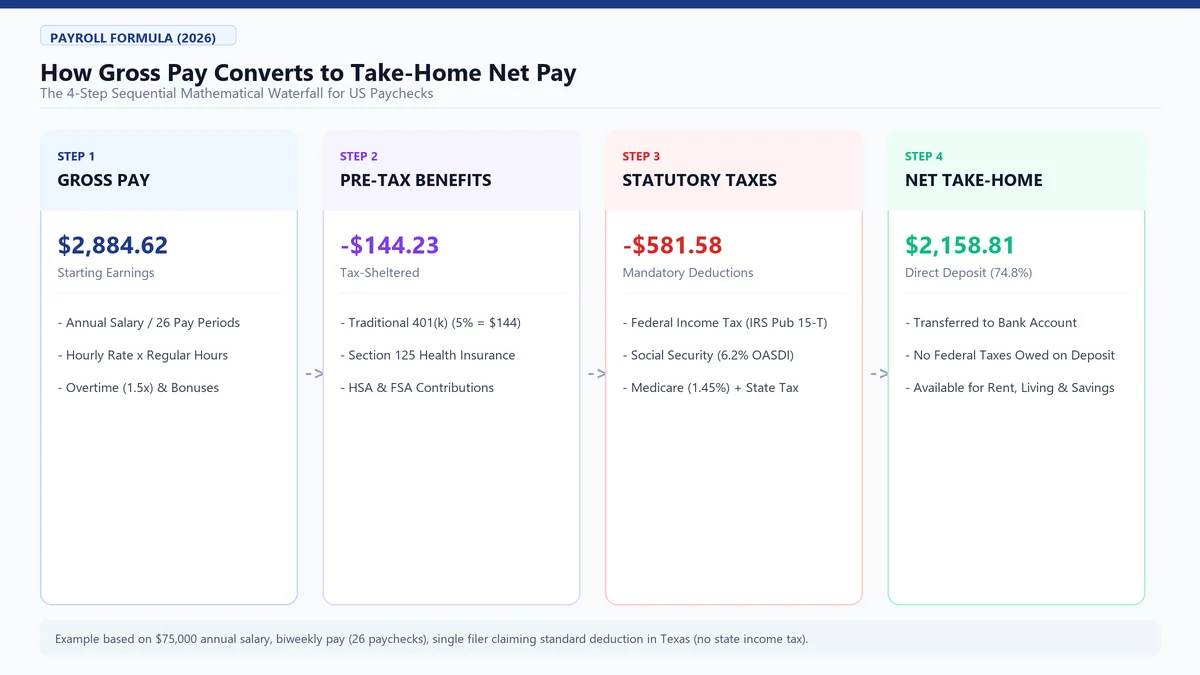
How Weekly Pay Is Calculated (Step-By-Step Gross-To-Net Formula)
Weekly payroll processes compensation across 52 pay periods per year. Calculating your net weekly take-home pay follows a structured statutory waterfall:
- Step 1: Calculate Weekly Gross Pay
For hourly workers, multiply regular hours (up to 40) by your hourly wage, and add overtime hours paid at 1.5 times your regular rate:Weekly Gross Pay = (Regular Hours ≤ 40 × Hourly Rate) + (Overtime Hours × 1.5 × Hourly Rate)For salaried employees, divide your annual base salary by 52:Weekly Gross Pay = Annual Salary / 52 - Step 2: Deduct Weekly Pre-Tax Benefits
Subtract pre-tax benefits prorated for 52 weekly pay periods (such as 401(k) contributions, medical/dental/vision premiums, HSA, and healthcare FSA elections). This yields your taxable gross wages. - Step 3: Calculate Mandatory Payroll Tax Withholdings
Apply federal, FICA, and state tax withholding formulas:- Federal Income Tax (FIT): Determined via IRS Publication 15-T weekly percentage withholding tables based on your Form W-4 elections.
- Social Security (OASDI): 6.2% on all earnings up to the 2026 cap of $184,500 (maximum $219.98 per week).
- Medicare: 1.45% on all earnings, plus 0.9% Additional Medicare Tax on cumulative earnings above $200,000 for single filers ($250,000 married).
- State & Local Income Taxes: Applied according to state tax brackets or flat statutory percentages.
- Step 4: Subtract Post-Tax Deductions
Subtract post-tax deductions (Roth 401(k), garnishments, voluntary union dues) to determine your Net Weekly Take-Home Pay.
Variable Hours and Weekly Payroll Tax Withholding Mechanics
If you work variable hours week-to-week (e.g., 30 hours one week and 55 hours the next), you will notice that taxes fluctuate significantly on your paystub. Here is why this happens:
- Annualized Payroll Withholding: Automated payroll software computes federal tax withholding on each weekly paycheck independently. It multiplies your weekly taxable gross by 52 to project an annualized salary, calculates tax on that projected amount, and divides the resulting annual tax by 52.
- The Overtime Tax Spike Effect: If you work heavy overtime in a single week, payroll software treats that check as if you make that elevated amount every single week of the year. This temporarily pushes a portion of that week's earnings into a higher marginal withholding bracket.
- Year-End True-Up: You never permanently lose money to higher withholding. When you file your annual Form 1040 tax return, your actual tax liability is calculated based on your total cumulative annual income. Any excess tax withheld during heavy overtime weeks is fully refunded.
High Earners and the Social Security Wage Cap on Weekly Payroll
For weekly earners with higher salaries, the 6.2% Social Security (OASDI) payroll tax stops once cumulative year-to-date earnings exceed $184,500 in 2026.
Once you reach this threshold, your weekly take-home pay experiences an automatic +6.2% bump for all remaining weeks in the calendar year:
| Annual Gross Salary | Weekly Gross Pay (52 Wks) | Week Social Security Cap Reached | Weekly Take-Home Increase (+6.2%) |
|---|---|---|---|
| $200,000 / yr | $3,846.15 | Week 48 (Late November) | +$238.46 / week |
| $250,000 / yr | $4,807.69 | Week 39 (Late September) | +$298.08 / week |
| $300,000 / yr | $5,769.23 | Week 33 (Mid August) | +$357.69 / week |
2026 Statutory Pre-Tax Contribution Limits per Weekly Paycheck
To maximize retirement and healthcare tax shelters across 52 weekly pay periods in 2026, set your per-paycheck elections according to statutory IRS limits:
| Account Type | 2026 Statutory Limit | Max Per Weekly Check (52 Checks) |
|---|---|---|
| Traditional 401(k) / 403(b) (Under 50) | $24,500 | $471.15 / week |
| 401(k) / 403(b) Catch-Up (Age 50+) | $32,500 ($24,500 + $8,000) | $625.00 / week |
| Health Savings Account (HSA) — Individual | $4,400 | $84.62 / week |
| Health Savings Account (HSA) — Family | $8,750 | $168.27 / week |
| Healthcare Flexible Spending Account (FSA) | $3,400 | $65.38 / week |
| Dependent Care FSA (DCFSA) | $5,000 | $96.15 / week |

Weekly Paycheck Conversion & Wage Benchmark Chart
The table below shows weekly gross pay across common hourly rates (40 hours/week) and annual salaries, along with estimated net take-home pay in a state with no income tax (Texas):
| Hourly Wage Rate | Weekly Gross (40 hrs) | Annual Gross (52 wks) | Est. Net Weekly Pay (TX / 0% Tax)* |
|---|---|---|---|
| $15.00 / hr | $600.00 | $31,200 / yr | $524 / week |
| $20.00 / hr | $800.00 | $41,600 / yr | $683 / week |
| $25.00 / hr | $1,000.00 | $52,000 / yr | $839 / week |
| $35.00 / hr | $1,400.00 | $72,800 / yr | $1,136 / week |
| $50.00 / hr | $2,000.00 | $104,000 / yr | $1,563 / week |
| $75.00 / hr | $3,000.00 | $156,000 / yr | $2,228 / week |
*Estimates based on 2026 single filer standard deduction with no pre-tax benefits in Texas (0% SIT). Enter your exact figures above for precise calculations.
Multi-State Weekly Take-Home Comparison ($1,000 Gross / $25 per Hour)
Where you live impacts what remains in your weekly paycheck. Here is a comparison of a $1,000 weekly gross paycheck ($52,000 annual salary) across different state tax jurisdictions:
| State | Weekly Gross | Federal + FICA Tax | State & Local Tax | Net Weekly Pay | Annual Net Difference vs TX |
|---|---|---|---|---|---|
| Texas / Florida (0% SIT) | $1,000.00 | $161.08 | $0.00 | $838.92 | Baseline ($0) |
| Illinois (4.95% Flat SIT) | $1,000.00 | $161.08 | $38.45 | $800.47 | -$1,999.40 / yr |
| California (Progressive + SDI) | $1,000.00 | $161.08 | $39.80 | $799.12 | -$2,069.60 / yr |
| New York City (NYS + NYC Local) | $1,000.00 | $161.08 | $58.90 | $780.02 | -$3,062.80 / yr |
Weekly Take-Home Pay by Hourly Wage Benchmark
| Hourly rate | Gross / pay | Net / pay | Net per year | Tax rate |
|---|---|---|---|---|
| $15/hr | $600.00 | $524.02 | $27,249 | 12.7% |
| $18/hr | $720.00 | $620.44 | $32,263 | 13.8% |
| $20/hr | $800.00 | $684.72 | $35,606 | 14.4% |
| $25/hr | $1,000.00 | $845.42 | $43,962 | 15.5% |
| $30/hr | $1,200.00 | $1,006.12 | $52,318 | 16.2% |
| $40/hr | $1,600.00 | $1,295.41 | $67,361 | 19% |
| $50/hr | $2,000.00 | $1,576.81 | $81,994 | 21.2% |
Calculations assume a standard 40-hour workweek, single filing status, Texas (no state income tax), and no deductions.
Top Industries Utilizing Weekly Pay Schedules
- Construction & Skilled Trades: Smooths weekly cash flow across project sites.
- Hospitality & Food Service: Combines base hourly wages with weekly credit card tip disbursements.
- Logistics & Warehousing: Provides fast access to earnings and overtime incentives.
- Staffing & Temporary Agencies: Offers immediate weekly placement compensation.
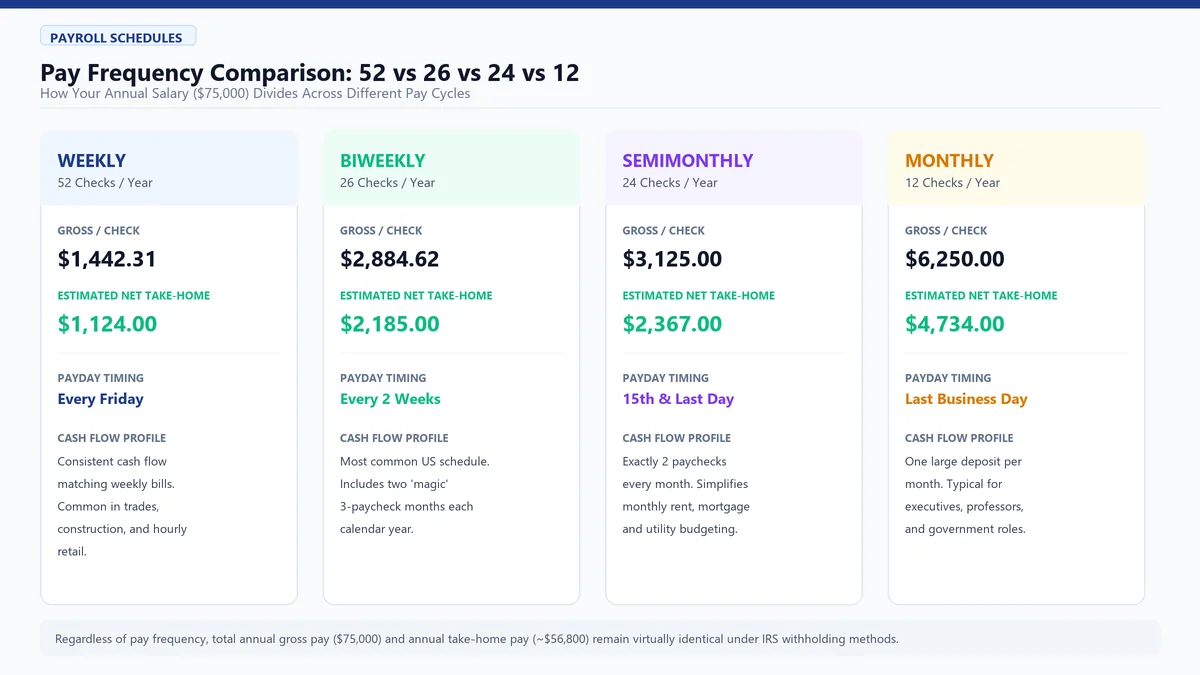
Weekly, Biweekly or Semimonthly: How Frequency Affects Your Checks
Same salary, different rhythm: weekly means 52 checks, biweekly 26 and semimonthly 24. Compare them on the pay frequency guide.
Example Scenarios
A restaurant server who earns $9 an hour plus tips reports tips as wages, so the weekly check includes tip income for tax. A tradesperson at $35 an hour grosses $1,400 for 40 hours. Model both with your state to see weekly take-home.
Frequently Asked Questions
How many paychecks are in a weekly pay year?
There are typically 52 paychecks per year in a weekly payroll system (365 days / 7 days = 52.14 weeks). Approximately once every 5 to 6 years, a calendar year contains 53 weekly pay periods.
How do I convert my hourly rate to weekly gross pay?
Multiply your hourly wage by the number of hours worked in the 7-day workweek. For example, $22.00/hour × 40 hours = $880.00 weekly gross pay.
How do I calculate weekly pay from an annual salary?
Divide your annual gross base salary by 52. For example, a $65,000 annual salary divided by 52 equals $1,250.00 weekly gross pay.
Why is more tax withheld when I work overtime in a single week?
Payroll software annualizes each weekly check independently by multiplying weekly gross by 52. High overtime weeks cause the automated algorithm to calculate taxes at a higher projected annual bracket for that single check. Any excess withholding is refunded when filing your Form 1040.
What is the maximum 401(k) deduction per week in 2026?
In 2026, the statutory elective deferral limit is $24,500. Divided across 52 weekly paychecks, the maximum weekly 401(k) contribution is $471.15 per week (or $625.00/week for employees age 50+).
When does Social Security tax stop on weekly paychecks?
Social Security tax (6.2%) stops once cumulative year-to-date earnings exceed $184,500 in 2026. If you earn $4,000 per week, the tax will stop around Week 47, increasing your take-home pay by $248/week for the rest of the year.
How accurate is the weekly paycheck calculator?
It assumes 52 similar weekly checks. Weeks with more hours, overtime or tips will pay differently, and payroll may round each check.
Is withholding lower on a weekly check?
Withholding is scaled to the pay period, so each weekly check has less tax taken out than a monthly one, but the yearly total is close to the same.
How these numbers are figured: 2026 IRS withholding rules (Publication 15-T) and state figures last verified September 2026. Results are estimates. Read the full methodology and sources.
Related Calculators and Guides
Want a state-specific result? Try California, Texas, New York, Florida.
or see all state calculators.