Overtime Paycheck Calculator
Overtime pay boosts your earnings by 1.5x (time-and-a-half) or 2.0x (double time) for hours worked beyond standard thresholds. Enter your regular hourly rate and overtime hours below to calculate your exact overtime gross pay, marginal tax withholding, FICA payroll taxes, and net take-home pay boost under 2026 rules.
How to Use the Overtime Paycheck Calculator
- Enter your hourly rate and regular hours (usually 40).
- Enter overtime hours per week and choose 1.5x or 2x.
- Select your state and weekly pay frequency.
- Compare net pay with and without overtime to see the real gain.

How Overtime Pay Is Calculated Under the Fair Labor Standards Act (FLSA)
Under the federal Fair Labor Standards Act (FLSA), covered non-exempt employees must receive overtime pay for all hours worked exceeding 40 hours in a single designated 7-day workweek at a rate not less than 1.5 times their regular rate of pay (known as time-and-a-half):
- Step 1: Determine the Regular Rate of Pay
Your regular rate includes your base hourly rate plus non-discretionary bonuses, shift differentials, and commissions.Overtime Hourly Rate = Regular Rate × 1.5 - Step 2: Calculate Total Gross Earnings
Multiply your regular rate by up to 40 hours, and multiply your overtime rate by all excess hours:Total Weekly Gross Pay = (Regular Rate × 40) + (Regular Rate × 1.5 × Overtime Hours) - Step 3: Apply Mandatory Tax Withholdings
Deduct federal income tax (via IRS Publication 15-T), Social Security (6.2% up to the 2026 cap of $184,500), Medicare (1.45%), and applicable state/local income taxes. - Step 4: Determine Net Overtime Take-Home
Subtract post-tax deductions to see the exact net cash gain delivered to your bank account.
State-Specific Overtime Mandates: California Daily Overtime and Double-Time Laws
While federal FLSA law only mandates overtime after 40 hours in a workweek, several states enforce stricter daily overtime and double-time regulations:
| Jurisdiction | Time-and-a-Half (1.5x) Threshold | Double-Time (2.0x) Threshold |
|---|---|---|
| Federal FLSA Standard | After 40 hours worked in a 7-day workweek | No federal requirement |
| California (Labor Code § 510) | • After 8 hours in a workday • After 40 hours in a workweek • First 8 hours on 7th consecutive day |
• After 12 hours in a single workday • After 8 hours on 7th consecutive day |
| Alaska | • After 8 hours in a workday • After 40 hours in a workweek |
No state mandate |
| Nevada | After 8 hours in a workday (for employees earning < 1.5x minimum wage) | No state mandate |
| Colorado | • After 12 hours in a workday • After 40 hours in a workweek |
No state mandate |
Calculating the True 'Regular Rate of Pay' (FLSA Section 7(e) Rules)
Under FLSA regulations, overtime is not simply calculated on your base hourly rate if you receive additional forms of compensation during the workweek. Employers must calculate the regular rate of pay by dividing total eligible compensation by total hours worked:
- Must Be Included in Regular Rate:
- Shift Differentials: Extra pay for night, weekend, swing, or hazardous shifts.
- Non-Discretionary Bonuses: Production bonuses, safety awards, attendance incentives, and performance bonuses promised in advance.
- Commissions: Nondiscretionary sales commissions earned during the pay period.
- Excludable from Regular Rate: Discretionary holiday gifts, reimbursement for business travel, paid time off (PTO/vacation/sick days when not worked), and true discretionary bonuses.
- Example Calculation: An employee earning $25/hour works 50 hours and receives a $100 attendance bonus.
Total straight pay = ($25 × 50) + $100 = $1,350.
Regular Rate = $1,350 / 50 hrs = $27.00/hour.
Overtime premium = 10 hrs × ($27.00 × 0.5) = $135.
Total Gross Pay = $1,350 + $135 = $1,485.00 (vs $1,375 under base rate).
Debunking the Overtime Tax Myth: Why Overtime Never Reduces Your Take-Home Pay
A persistent workplace myth claims that “working overtime pushes you into a higher tax bracket, so you end up making less money.” This is mathematically impossible under the US progressive tax system:
- How Progressive Brackets Work: Moving into a higher tax bracket only taxes the incremental dollars earned above that bracket threshold at the higher percentage rate. Your initial earnings continue to be taxed at the exact same lower rates (10%, 12%, 22%, etc.).
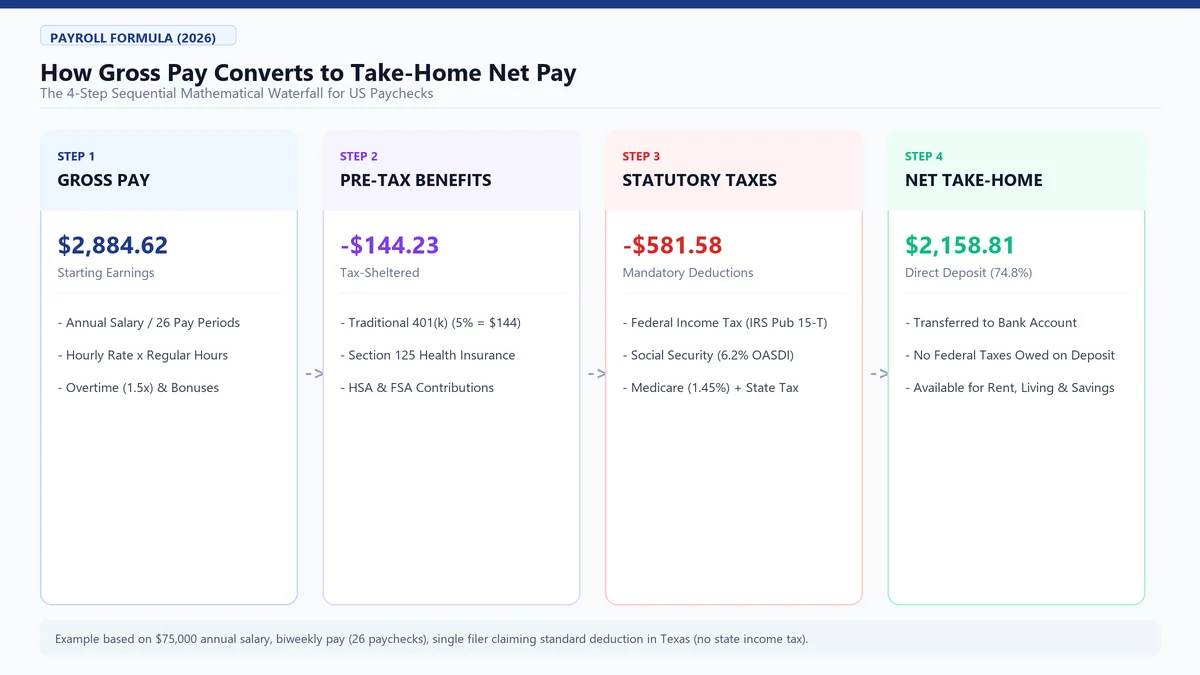
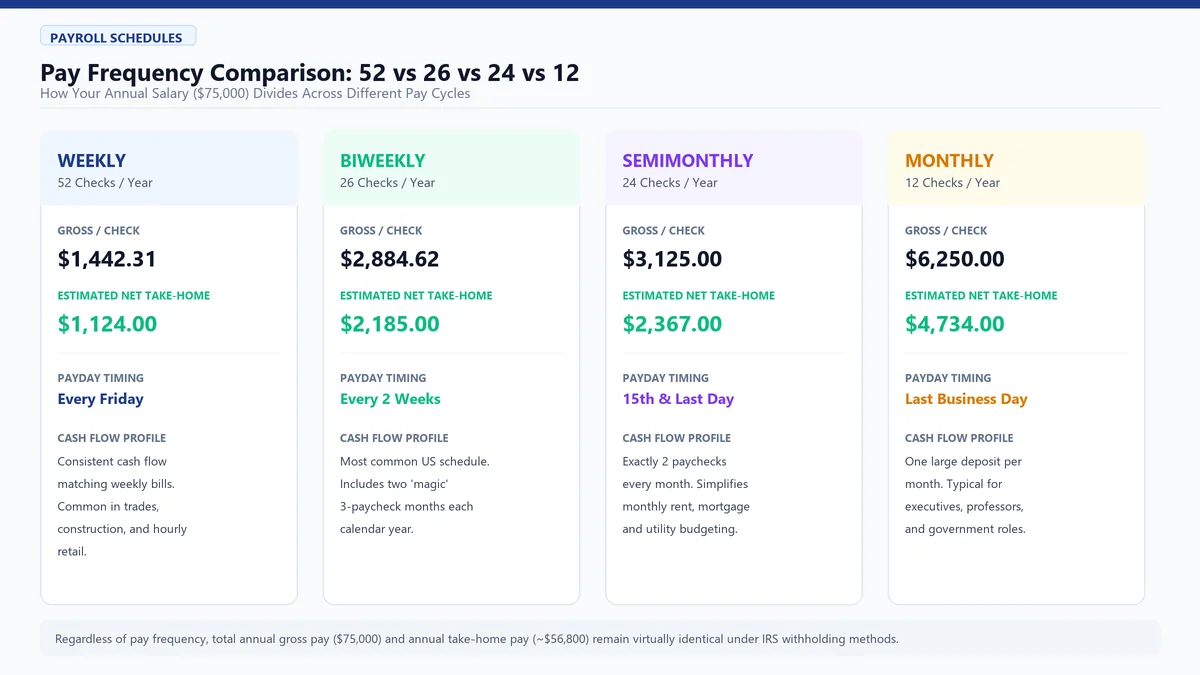
- Why Paychecks Look Heavily Taxed: Automated payroll systems annualize each individual check. A large overtime check triggers withholding as if you earn that elevated amount 52 weeks a year. While more tax is withheld from that specific check, you still take home the substantial majority of your overtime earnings.
- IRS Tax Refund True-Up: If your employer withholds more tax than your actual annual effective tax rate requires, every cent of excess withholding is refunded to you when you file your annual tax return. You always make more money by working overtime.

Overtime Pay Rates Reference Table ($15 to $75 per Hour)
The table below details standard hourly wages, 1.5x time-and-a-half overtime rates, 2.0x double-time rates, and total gross compensation for 10 and 20 overtime hours in a single week:
| Base Hourly Rate | 1.5x Overtime Rate | 2.0x Double Time Rate | Gross for 50 Hrs (10 OT hrs) | Gross for 60 Hrs (20 OT hrs) |
|---|---|---|---|---|
| $15.00 / hr | $22.50 / hr | $30.00 / hr | $825.00 | $1,050.00 |
| $20.00 / hr | $30.00 / hr | $40.00 / hr | $1,100.00 | $1,400.00 |
| $25.00 / hr | $37.50 / hr | $50.00 / hr | $1,375.00 | $1,750.00 |
| $35.00 / hr | $52.50 / hr | $70.00 / hr | $1,925.00 | $2,450.00 |
| $50.00 / hr | $75.00 / hr | $100.00 / hr | $2,750.00 | $3,500.00 |
| $75.00 / hr | $112.50 / hr | $150.00 / hr | $4,125.00 | $5,250.00 |
Multi-State Net Take-Home on 10 Overtime Hours ($30/hour Base Rate)
The table below shows how a 50-hour workweek (40 regular hours @ $30/hr + 10 overtime hours @ $45/hr = $1,650.00 gross) converts to net take-home pay across different state tax environments:
| State | Total Weekly Gross (50 hrs) | Federal + FICA Withholding | State & Local Tax | Net Take-Home Pay | Net Gain from 10 OT Hours |
|---|---|---|---|---|---|
| Texas / Florida (0% SIT) | $1,650.00 | $312.45 | $0.00 | $1,337.55 | +$346.50 net |
| Illinois (4.95% Flat SIT) | $1,650.00 | $312.45 | $72.45 | $1,265.10 | +$324.23 net |
| California (Progressive + SDI) | $1,650.00 | $312.45 | $87.80 | $1,249.75 | +$315.70 net |
| New York City (NYS + NYC Local) | $1,650.00 | $312.45 | $119.50 | $1,218.05 | +$292.75 net |
How Overtime Hours Increase Net Take-Home Pay
| Overtime hours / week | Gross weekly | Net weekly | Net per year |
|---|---|---|---|
| 0 | $800.00 | $684.72 | $35,606 |
| 5 | $950.00 | $805.25 | $41,873 |
| 10 | $1,100.00 | $925.77 | $48,140 |
| 15 | $1,250.00 | $1,046.30 | $54,408 |
| 20 | $1,400.00 | $1,154.71 | $60,045 |
Based on a $20/hr base rate, 40 regular hours, overtime paid at 1.5x ($30/hr), single filer in Texas. Notice net take-home pay rises predictably with every extra overtime hour worked.
Overtime and Bonus Withholding Rules
Overtime is classified as ordinary wages, but bonuses and commissions are supplemental wages withheld at a flat 22% federal rate. See our guide on payroll taxes for withholding details.
Overtime Deduction 2025-2028: Is Overtime Tax-Free?
Not at the paycheck. The 2025 tax law lets many workers deduct up to $12,500 of qualified overtime premium pay ($25,000 joint) on their tax return, phasing out above $150,000 MAGI ($300,000 joint). Withholding shown by this calculator does not include that deduction. Full rules: no tax on overtime and tips.
Example Scenarios
A worker at $20 an hour who adds 5 overtime hours earns $150 more gross a week, while 10 hours adds $300 and 15 hours adds $450. Federal tax, Social Security and Medicare apply to every extra dollar, so net gain is smaller than gross. See the table above.
Frequently Asked Questions
How do you calculate time-and-a-half pay?
Multiply your regular hourly rate by 1.5. For example, if your base pay is $20.00 per hour, your time-and-a-half overtime rate is $30.00 per hour ($20 × 1.5).
When does an employee qualify for overtime under federal law?
Under the FLSA, non-exempt employees must receive overtime pay of at least 1.5 times their regular rate for all hours worked exceeding 40 hours during a standard 7-day workweek.
Does working overtime ever cause you to lose money in taxes?
No, never. The United States uses progressive marginal tax brackets. Only the additional overtime dollars earned above a bracket threshold are taxed at the higher marginal rate. You always keep the majority of every overtime dollar earned.
What is double-time pay and when is it required?
Double-time is pay calculated at 2.0 times your regular hourly rate. While federal law does not mandate double time, states like California require double-time pay for hours worked past 12 hours in a single workday or past 8 hours on the 7th consecutive day of work.
Are salaried employees eligible for overtime?
Salaried employees are only exempt from overtime if they earn at least the federal salary threshold ($684 per week, or $35,568 a year, in 2026; some states set higher levels) and also pass a duties test for an executive, administrative, professional or similar exemption. Non-exempt salaried workers are entitled to overtime pay.
Are bonuses included in overtime calculations?
Yes. Non-discretionary bonuses (such as attendance, safety, or production bonuses) must be factored into your regular rate of pay when calculating overtime under FLSA Section 7(e) rules.
How accurate is the overtime paycheck calculator?
It applies the multiplier you choose to the overtime hours you enter. Your employer may compute the regular rate including bonuses, so overtime pay can be slightly higher than the estimate.
Does overtime get withheld at a higher rate?
Overtime is ordinary wages, so it uses the same withholding method, but extra pay in one check can make withholding look larger. You get any difference back when you file.
How these numbers are figured: 2026 IRS withholding rules (Publication 15-T) and state figures last verified September 2026. Results are estimates. Read the full methodology and sources.
Related Calculators and Guides
Want a state-specific result? Try California, Texas, New York, Florida.
or see all state calculators.