401(k) Paycheck Deductions Explained
How 401(k) contributions change your paycheck in 2026: traditional vs Roth, 2026 IRS contribution caps, employer matching math, and take-home pay calculators.
Contributing to a 401(k) retirement plan is one of the most effective ways to build long-term wealth while managing your current tax bill. In 2026, the IRS allows employees to defer up to $24,500 into a 401(k) ($32,500 for age 50+). Below is the complete guide to how traditional and Roth 401(k) deductions affect your paycheck and take-home pay.

Traditional 401(k) vs Roth 401(k): Complete Paycheck Comparison
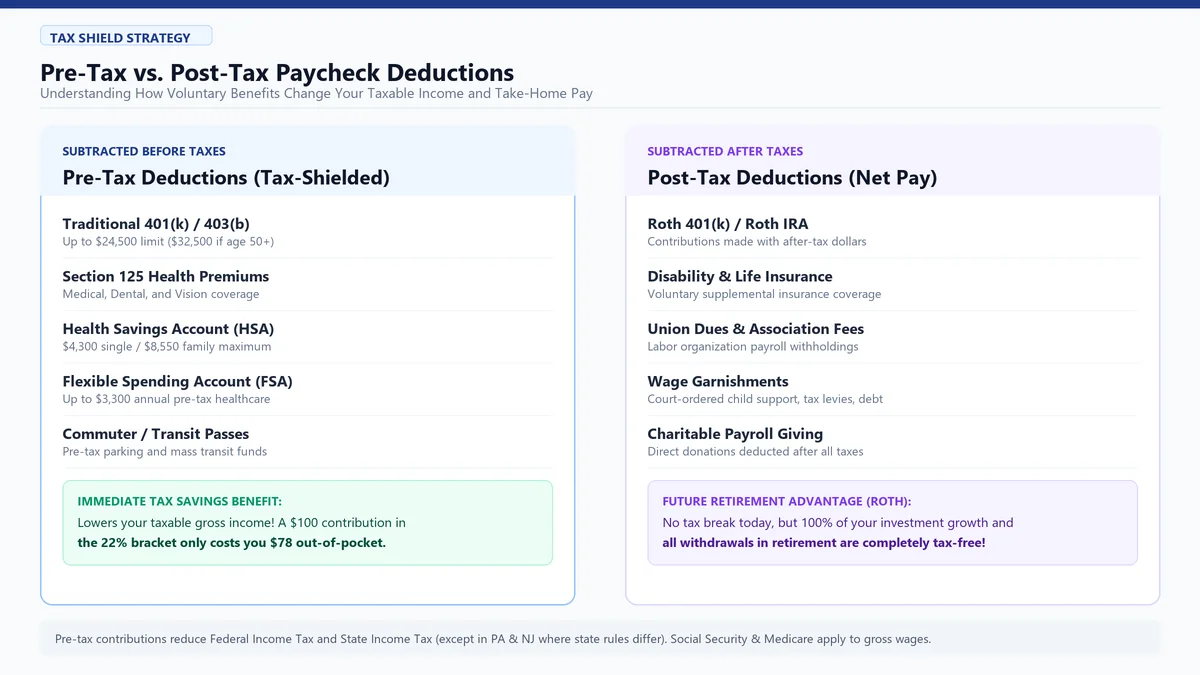
Understanding how Traditional vs Roth 401(k) elections affect your paycheck is essential for tax planning:
| Feature | Traditional 401(k) | Roth 401(k) |
|---|---|---|
| Tax Timing | Pre-Tax: Deducted before income taxes are calculated. | Post-Tax: Deducted after all payroll taxes are calculated. |
| Immediate Paycheck Impact | Reduces current federal and state tax withholding; take-home pay drops by less than the contribution. | No immediate tax savings; take-home pay drops dollar-for-dollar by the contribution amount. |
| Retirement Withdrawals | Taxed as ordinary income upon withdrawal in retirement. | 100% Tax-Free withdrawals in retirement (both principal and compound earnings). |
| 2026 Annual Limit | $24,500 ($32,500 for age 50+) | Shared $24,500 limit with Traditional ($32,500 for age 50+) |
| Best Suited For | Workers currently in high tax brackets who expect to be in lower brackets in retirement. | Early-career workers in lower tax brackets or those seeking tax diversification in retirement. |
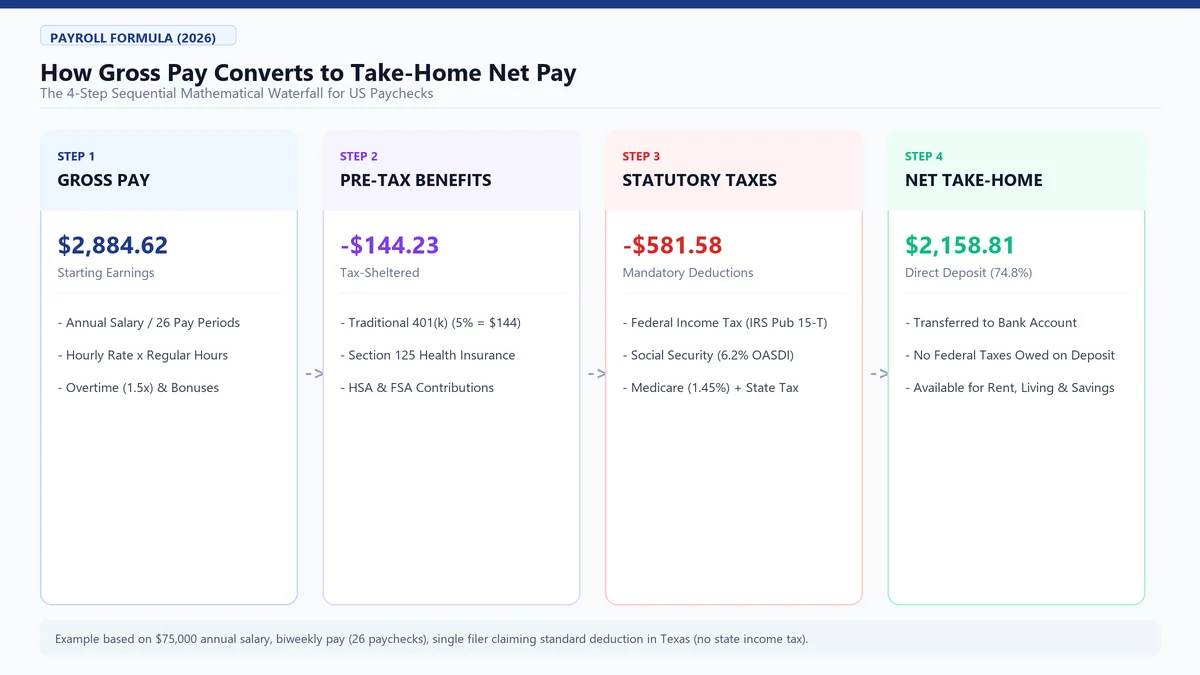
2026 IRS Contribution Limits: Standard, Catch-Up & Super Catch-Up
Under the IRS cost-of-living adjustments for 2026 and provisions of the SECURE 2.0 Act, the 401(k) contribution thresholds are:
- Standard Employee Elective Deferral: $24,500 per calendar year (up from $23,500 in 2025).
- Age 50+ Catch-Up Contribution: Additional $8,000 (total $32,500 for employees age 50 and older).
- SECURE 2.0 Super Catch-Up (Ages 60 to 63): Employees aged 60, 61, 62, or 63 can contribute an enhanced catch-up limit of $11,250 (total $35,750).
- Total Plan Limit (Employee + Employer Match): Section 415(c) total defined contribution cap is $70,000 (or $78,000 with age 50+ catch-up).
The True Paycheck Cost of a 401(k) Contribution (the Tax Buffer)
The table below illustrates how different traditional pre-tax 401(k) contribution percentages affect gross vs net take-home pay for an employee earning a $75,000 salary ($2,884.62 biweekly gross) in Texas (22% federal bracket, 0% state tax):
| 401(k) Contribution % | Biweekly 401(k) Saved | Federal Tax Savings | Net Take-Home Pay | Actual Paycheck Reduction |
|---|---|---|---|---|
| 0% (No Contribution) | $0.00 | $0.00 | $2,331.14 / check | Baseline ($0) |
| 3% Contribution | $86.54 | $19.04 | $2,263.64 / check | -$67.50 / check |
| 6% Contribution | $173.08 | $38.08 | $2,196.14 / check | -$135.00 / check |
| 10% Contribution | $288.46 | $63.46 | $2,106.14 / check | -$225.00 / check |
| Max Out ($24,500/yr) | $942.31 | $207.31 | $1,596.14 / check | -$735.00 / check |

Employer Matching Contributions: Free Money & Immediate 100% ROI
Many employers offer a 401(k) matching formula (e.g., 50% or 100% match on the first 3% to 6% of salary):
- Immediate 100% Return: If your employer matches 100% up to 4% on a $75,000 salary, contributing $3,000 earns you an immediate $3,000 company match — an instant 100% risk-free return on your money.
- Employer Match Tax Treatment: Employer matching funds are deposited into a traditional pre-tax bucket (unless your company offers SECURE 2.0 Roth match elections) and do not count toward your personal $24,500 elective deferral limit.
Do 401(k) Deductions Reduce Social Security or Medicare Taxes?
Under IRC Section 3121, 401(k) contributions are explicitly excluded from FICA tax exemption. While traditional 401(k) deductions lower federal and state income taxes, you must still pay the mandatory 6.2% Social Security and 1.45% Medicare tax on the entire gross contribution amount.
Traditional 401(k) Contribution by Percentage
| 401(k) rate | Per paycheck | Net pay | Net pay drop |
|---|---|---|---|
| None | $0.00 | $2,368.94 | $0.00 |
| 3% | $86.54 | $2,301.44 | $67.50 |
| 6% | $173.08 | $2,233.94 | $135.00 |
| 10% | $288.46 | $2,143.94 | $225.00 |
| 15% | $432.69 | $2,020.87 | $348.08 |
The drop in net pay is always smaller than the amount contributed, because federal tax falls. Single filer, $75,000, biweekly, Texas.
Roth vs Traditional: Which Lowers Your Paycheck More?
A Roth 401(k) contribution lowers your paycheck by the full amount you contribute because it is after-tax. A traditional contribution lowers it by less. The trade-off is timing: pay tax now with Roth, or later on withdrawals with traditional. Many people split contributions between both.
401(k) Mistakes to Avoid
- Missing the employer match.
- Contributing a flat dollar amount that hits the $24,500 limit before year end, which can stop your employer match if your plan matches per paycheck.
- Ignoring vesting schedules when changing jobs.
- Forgetting that Pennsylvania and New Jersey tax 401(k) contributions at the state level.
Frequently Asked Questions
How much does contributing to a 401(k) lower my paycheck?
Because traditional 401(k) contributions are pre-tax, they lower your income taxes. If you are in the 22% federal bracket, a $100 contribution only reduces your net take-home pay by $78.00 (or less in states with income tax).
What is the maximum 401(k) contribution in 2026?
In 2026, the employee elective deferral limit is $24,500. Workers age 50 and older can contribute an additional $8,000 catch-up ($32,500 total). Workers aged 60-63 can contribute up to $35,750 under SECURE 2.0.
Is a Traditional 401(k) or Roth 401(k) better for my paycheck?
A Traditional 401(k) gives you larger take-home pay today because it provides an immediate tax deduction. A Roth 401(k) reduces take-home pay more today, but provides 100% tax-free withdrawals in retirement.
Does employer matching count toward the $24,500 limit?
No. The $24,500 limit applies only to employee salary deferrals. Employer matching contributions count toward the overall Section 415(c) plan limit of $70,000 in 2026.
Can I stop or change my 401(k) contribution percentage at any time?
Yes. Unlike healthcare FSA or health insurance plans, you can adjust, increase, decrease, or pause your 401(k) contribution percentage at any time during the year through your employer’s benefits portal.
Do 401(k) contributions reduce state income taxes?
In 49 states and the District of Columbia, traditional 401(k) contributions reduce state taxable income dollar-for-dollar. Only Pennsylvania taxes 401(k) employee contributions at the state level.
Does a 401(k) reduce Social Security tax?
No. Traditional 401(k) deferrals reduce income tax but not Social Security or Medicare wages.
How these numbers are figured: 2026 IRS withholding rules (Publication 15-T) and state figures last verified September 2026. Results are estimates. Read the full methodology and sources.