Biweekly Paycheck Calculator
Biweekly pay means 26 paychecks a year, delivered every two weeks (typically every alternating Friday). Enter your annual base salary or regular hourly wage below to calculate your exact biweekly gross pay, pre-tax benefit deductions, 2026 federal withholding, FICA payroll taxes (Social Security and Medicare), state income tax, and net take-home pay per paycheck.
How to Use the Biweekly Paycheck Calculator
- Enter salary, or switch to Hourly and enter your rate and hours.
- Keep pay frequency on Biweekly (26 per year).
- Pick your state, then add deductions under More options.
- Read net pay per paycheck.

How Biweekly Pay Is Calculated (the 4-step Gross-To-Net Waterfall)
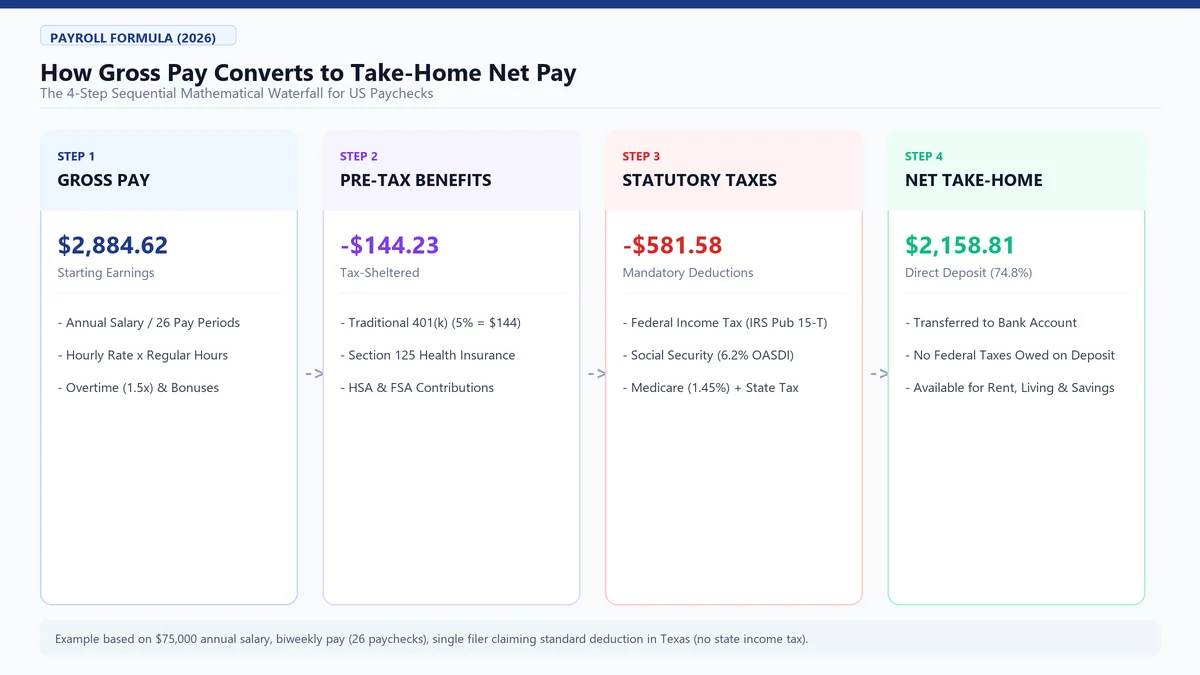
Calculating your biweekly take-home pay requires following a precise four-step statutory payroll waterfall. Because a biweekly pay schedule consists of exactly 26 pay periods per calendar year (52 weeks divided by 2), each biweekly paycheck represents 1/26th of your annual compensation or 80 regular working hours:
- Step 1: Calculate Biweekly Gross Pay
For salaried employees, divide your annual gross salary by 26:Biweekly Gross Pay = Annual Base Salary / 26For hourly employees working full-time (40 hours per week), multiply your regular hourly rate by 80 hours:Biweekly Gross Pay = (Hourly Rate × 80 Regular Hours) + (Overtime Hours × 1.5 × Hourly Rate) - Step 2: Deduct Pre-Tax Benefits
Subtract pre-tax deductions exempt under IRS Section 125 and Section 401(k), including traditional 401(k)/403(b) retirement contributions, health insurance premiums (medical, dental, vision), Health Savings Account (HSA), and Flexible Spending Account (FSA) elections. This determines your federal and state taxable wage base. - Step 3: Withhold Federal, FICA, and State Taxes
Apply statutory payroll withholding formulas to your taxable wage base:- Federal Income Tax (FIT): Calculated using IRS Publication 15-T percentage tables based on your Form W-4 filing status (Single, Married Filing Jointly, Head of Household) and credits.
- Social Security (OASDI): 6.2% on all gross wages up to the 2026 wage base limit of $184,500 (maximum $11,439.00 annually or $439.96/check).
- Medicare: 1.45% on all earnings without any cap, plus a 0.9% Additional Medicare Tax on cumulative earnings exceeding $200,000 for single filers ($250,000 married).
- State and Local Income Taxes (SIT/LIT): Calculated based on your state of residence/employment brackets, flat rates, or local municipal levies.
- Step 4: Subtract Post-Tax Deductions
Deduct post-tax obligations such as Roth 401(k) contributions, union dues, voluntary life insurance, and statutory wage garnishments. The remainder is your Net Take-Home Pay directly deposited into your bank account.
Biweekly vs Semimonthly Payroll: Key Differences & Paycheck Size
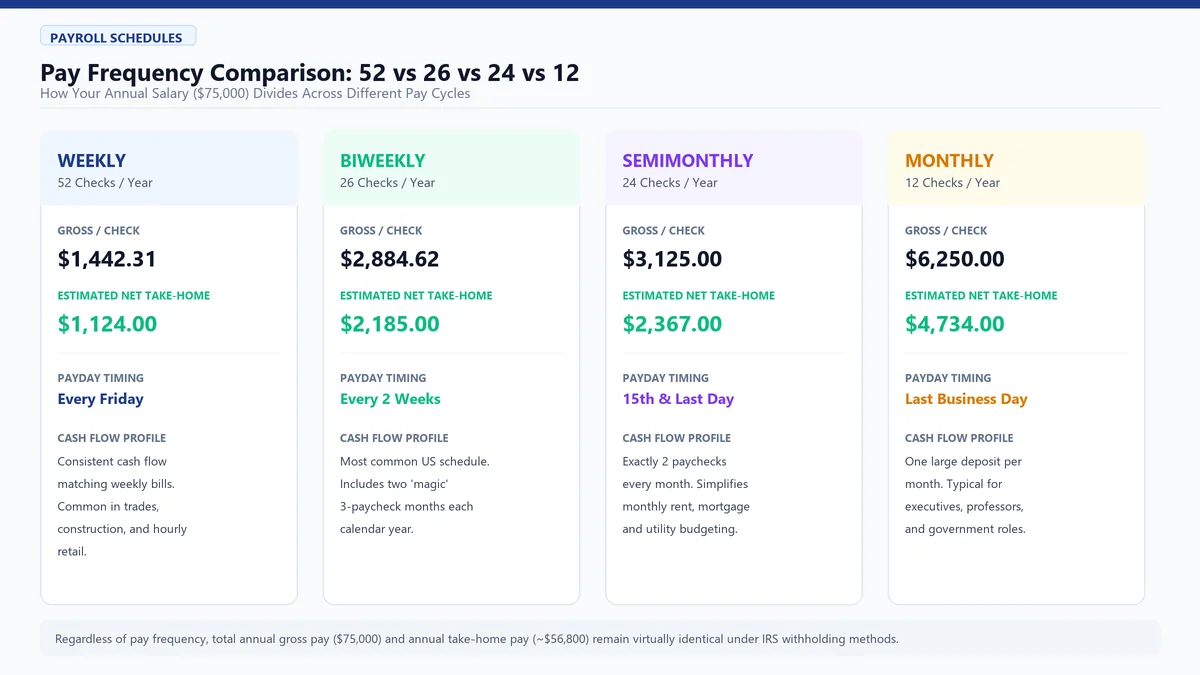
While often confused, biweekly (26 paychecks per year) and semimonthly (24 paychecks per year) operate on fundamentally different payroll calendars with significant cash flow implications:
| Feature | Biweekly Payroll | Semimonthly Payroll |
|---|---|---|
| Paychecks Per Year | 26 paychecks | 24 paychecks |
| Payment Frequency | Every 14 days on a set weekday (e.g., alternating Fridays) | Twice per month on specific calendar dates (e.g., 15th & last day) |
| Gross Pay on $78,000 Salary | $3,000.00 per paycheck ($78,000 / 26) | $3,250.00 per paycheck ($78,000 / 24) |
| Gross Pay on $100,000 Salary | $3,846.15 per paycheck ($100,000 / 26) | $4,166.67 per paycheck ($100,000 / 24) |
| Monthly Check Distribution | 10 months have 2 checks; 2 months have 3 checks | Every month has exactly 2 paychecks |
| Overtime Tracking | Simple — aligns cleanly with standard 80-hour 2-week work cycles | Complex — pay periods split workweeks across calendar dates |
Key Takeaway: Because biweekly divides your salary into 26 checks rather than 24, each biweekly paycheck is approximately 7.69% smaller than a semimonthly paycheck for the exact same annual salary. However, biweekly employees receive two extra paychecks each year to reach the identical annual compensation.
The Two 3-paycheck 'Magic Months': 2026 Calendar Strategy & Wealth Building
Because there are 52 weeks in a calendar year, 26 biweekly pay periods do not divide evenly into 12 calendar months. In exactly 10 months of the year, you receive 2 paychecks, and in 2 months of the year, you receive 3 paychecks.
These two 3-paycheck months — often called “magic paycheck months” — create a powerful wealth-building opportunity if managed intentionally:
- How to identify your 3-paycheck months: If your first biweekly paycheck of 2026 is paid on Friday, January 2, 2026, your 3-paycheck months will be January (Jan 2, Jan 16, Jan 30) and July (Jul 3, Jul 17, Jul 31). If your first paycheck falls on Friday, January 9, 2026, your 3-paycheck months will be May (May 1, May 15, May 29) and October (Oct 2, Oct 16, Oct 30).
- The 2-Paycheck Budgeting Rule: Build your baseline monthly living budget (rent/mortgage, utilities, food, debt minimums, and subscriptions) based entirely on two biweekly paychecks per month (24 paychecks total).
- Deploying the 3rd Paycheck for Wealth Building: Because your fixed monthly expenses are already covered by the first two checks of the month, the entire net amount of the 3rd paycheck is surplus discretionary cash flow. Common high-impact allocations include:
- Emergency Fund Acceleration: Fund 3 to 6 months of living expenses in a high-yield savings account.
- Debt Snowball/Avalanche: Make large lump-sum principal payments on high-interest credit cards or auto loans.
- Maxing Out Roth IRAs or HSAs: Make lump-sum contributions toward annual tax-advantaged accounts.
- Annual Insurance / Property Tax Sinking Funds: Pre-fund semi-annual or annual lump-sum liabilities without monthly budget strain.
2026 Statutory Pre-Tax Contribution Limits per Biweekly Paycheck
Maximizing pre-tax payroll deductions reduces your taxable wage base dollar-for-dollar, lowering both federal and state income tax liabilities. To max out tax-advantaged accounts evenly across all 26 biweekly pay periods in 2026, set your per-paycheck contributions as follows:
| Account Type | 2026 Annual Statutory Limit | Max Per Biweekly Check (26 Checks) |
|---|---|---|
| Traditional 401(k) / 403(b) (Under 50) | $24,500 | $942.31 / check |
| 401(k) / 403(b) Catch-Up (Age 50+) | $32,500 ($24,500 + $8,000) | $1,250.00 / check |
| Health Savings Account (HSA) — Individual | $4,400 | $169.23 / check |
| Health Savings Account (HSA) — Family | $8,750 | $336.54 / check |
| Healthcare Flexible Spending Account (FSA) | $3,400 | $130.77 / check |
| Dependent Care FSA (DCFSA) | $5,000 | $192.31 / check |

Biweekly to Hourly Wage Conversion Chart
To convert your biweekly gross pay to an equivalent hourly wage, divide the biweekly gross amount by 80 standard working hours (assuming a 40-hour full-time workweek). Multiply by 26 pay periods to calculate your annual gross compensation:
| Biweekly Gross Pay | Equivalent Hourly Rate (80 hrs) | Annual Gross Salary (26 checks) | Est. Biweekly Net (TX / No State Tax)* |
|---|---|---|---|
| $1,600.00 | $20.00 / hr | $41,600 / yr | $1,365 / check |
| $2,000.00 | $25.00 / hr | $52,000 / yr | $1,678 / check |
| $2,500.00 | $31.25 / hr | $65,000 / yr | $2,058 / check |
| $3,000.00 | $37.50 / hr | $78,000 / yr | $2,422 / check |
| $3,846.15 | $48.08 / hr | $100,000 / yr | $3,025 / check |
| $5,769.23 | $72.12 / hr | $150,000 / yr | $4,285 / check |
*Estimated take-home pay based on 2026 single filer standard deduction in Texas (0% state tax) with no pre-tax benefit deductions. Use our interactive calculator above for custom numbers.
Multi-State Biweekly Take-Home Comparison ($75,000 Salary / $2,884.62 Gross)
State and local income taxes significantly alter your net biweekly paycheck. The table below illustrates how a $75,000 annual salary ($2,884.62 biweekly gross) translates to net take-home pay across different state tax regimes:
| State | Biweekly Gross | Federal + FICA Tax | State & Local Tax | Net Biweekly Pay | Annual Net Difference vs TX |
|---|---|---|---|---|---|
| Texas / Florida (0% SIT) | $2,884.62 | $553.48 | $0.00 | $2,331.14 | Baseline ($0) |
| Illinois (4.95% Flat SIT) | $2,884.62 | $553.48 | $130.42 | $2,200.72 | -$3,390.92 / yr |
| California (Progressive + 1.1% SDI) | $2,884.62 | $553.48 | $154.20 | $2,176.94 | -$4,009.20 / yr |
| New York City (NYS + NYC Local) | $2,884.62 | $553.48 | $218.60 | $2,112.54 | -$5,683.60 / yr |
Living in a state without individual income tax saves a $75,000 worker between $3,390 and $5,680 annually in direct payroll tax deductions.
Biweekly Take-Home Pay by Annual Salary Benchmark
| Salary | Gross / pay | Net / pay | Net per year | Tax rate |
|---|---|---|---|---|
| $35,000 | $1,346.15 | $1,165.48 | $30,302 | 13.4% |
| $50,000 | $1,923.08 | $1,629.04 | $42,355 | 15.3% |
| $65,000 | $2,500.00 | $2,092.60 | $54,408 | 16.3% |
| $80,000 | $3,076.92 | $2,504.23 | $65,110 | 18.6% |
| $100,000 | $3,846.15 | $3,045.38 | $79,180 | 20.8% |
| $125,000 | $4,807.69 | $3,719.37 | $96,704 | 22.6% |
| $150,000 | $5,769.23 | $4,376.58 | $113,791 | 24.1% |
Figures assume single filing status in Texas (no state income tax), claiming standard deductions with no pre-tax benefit elections. Select your state on the calculator to reflect local tax rules.
What a Raise Adds to Each Biweekly Check
A $5,000 raise on a $75,000 salary adds about $192 gross to each biweekly check, but only about $134 reaches your account after 22% federal tax and 7.65% FICA in a no-tax state. See our salary calculator for full raise projections.
Example Scenarios
A $52,000 salary pays $2,000 gross biweekly, $65,000 pays $2,500, and $90,000 pays $3,461.54. Federal tax per check rises faster than pay because of progressive brackets, so take-home grows by less than gross when you get a raise.
Frequently Asked Questions
How many paychecks are in a biweekly year?
A standard biweekly payroll schedule contains 26 paychecks per year (52 weeks divided by 2). In leap years or specific 11-year calendar cycles, some employers experience a 27-paycheck payroll year depending on calendar start dates.
What is the difference between biweekly and semimonthly?
Biweekly occurs every 14 days (26 paychecks/year) on a fixed day of the week like Friday. Semimonthly occurs twice a month on fixed calendar dates (24 paychecks/year, like the 15th and last day of the month). Biweekly checks are ~7.7% smaller, but you receive two extra paychecks annually.
What are the two 3-paycheck 'magic months'?
Because 26 paychecks are distributed across 12 calendar months, two months every year contain three paychecks instead of two. If your budget is calibrated to two paychecks per month, the 3rd check in those two months can be dedicated entirely to savings, investments, or debt paydown.
How do I convert my annual salary to biweekly gross pay?
To calculate your biweekly gross pay, divide your annual gross salary by 26. For example, an $80,000 annual salary yields a biweekly gross pay of $3,076.92 before taxes and pre-tax deductions.
How do I convert biweekly pay to an hourly rate?
Assuming a full-time 40-hour workweek (80 hours per biweekly pay period), divide your biweekly gross pay by 80. For example, a biweekly gross check of $2,400 divided by 80 equals an hourly rate of $30.00/hour.
Why does my biweekly paycheck change when I hit the Social Security cap?
In 2026, the 6.2% Social Security tax only applies to the first $184,500 of cumulative earnings. Once your year-to-date gross salary crosses $184,500, Social Security withholding drops to $0 for all remaining biweekly checks in that calendar year, boosting your net take-home pay by 6.2%.
How accurate is the biweekly paycheck calculator?
It assumes 26 equal paychecks. In the two months a year with three paychecks the total is higher, but each check is the same. Deductions taken only twice a month will not match.
Why is my biweekly check different from half a monthly check?
Biweekly pay divides by 26 while monthly pay divides by 12, so a biweekly check is smaller than half of a monthly one. See pay frequency explained.
How these numbers are figured: 2026 IRS withholding rules (Publication 15-T) and state figures last verified September 2026. Results are estimates. Read the full methodology and sources.
Related Calculators and Guides
Want a state-specific result? Try California, Texas, New York, Florida.
or see all state calculators.