Medicare Tax: How Much Is Taken From Your Paycheck?
Medicare tax is 1.45% on all earnings with no cap, plus 0.9% Additional Medicare Tax above $200,000 in 2026. See withholding rules, examples, and exemptions.
Medicare tax — designated as HI (Hospital Insurance) on paystubs — is the second component of federal FICA payroll taxes. Unlike Social Security tax, Medicare tax has no wage limit. Below is the complete guide to standard Medicare tax, the 0.9% Additional Medicare Tax under the Affordable Care Act, and how it affects your take-home pay.

2026 Medicare Tax Rates & Statutory Structure
Medicare payroll tax operates under a dual-tier statutory structure in 2026:
| Tier | Employee Rate | Employer Rate | Annual Wage Threshold |
|---|---|---|---|
| Standard Medicare (HI) | 1.45% | 1.45% (total 2.9%) | All wages ($0 to infinity — No Cap) |
| Additional Medicare Tax | +0.9% (total 2.35%) | $0 (No Employer Match) | Wages exceeding $200,000 ($250,000 Married Joint) |
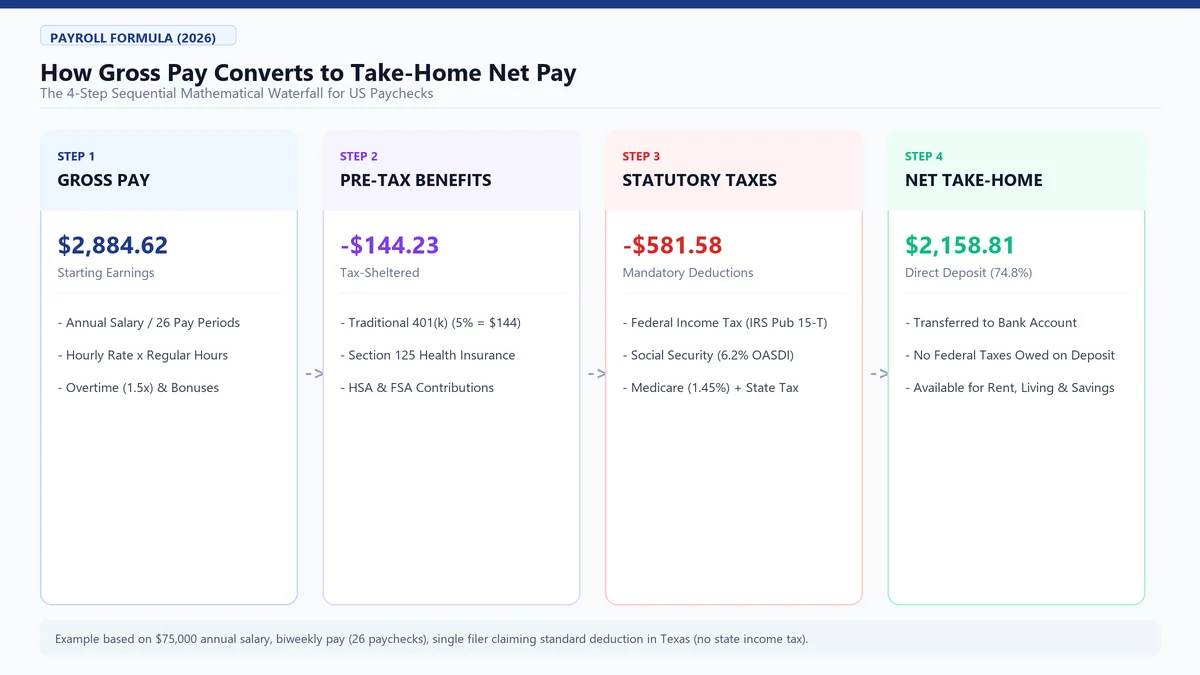
How the 0.9% Additional Medicare Tax Works (Affordable Care Act)
Under IRC Section 3101(b), an Additional Medicare Tax of 0.9% applies to wages exceeding specific statutory thresholds based on filing status:
- Single / Head of Household: Applies to compensation over $200,000.
- Married Filing Jointly: Applies to combined spousal compensation over $250,000.
- Married Filing Separately: Applies to compensation over $125,000.
- Mandatory Employer Withholding Rule: Employers are required to begin withholding the 0.9% tax once an employee's wages exceed $200,000 in a calendar year, regardless of the employee's marital status or spouse's income.
Medicare Tax Deduction Table Across Common Income Levels
The table below shows annual Medicare tax and per-paycheck deductions across common salary levels in 2026:
| Annual Gross Salary | Standard 1.45% Tax | 0.9% Additional Tax | Total Annual Medicare Tax | Biweekly Medicare Deduction |
|---|---|---|---|---|
| $50,000 / yr | $725.00 | $0.00 | $725.00 | $27.88 / check |
| $100,000 / yr | $1,450.00 | $0.00 | $1,450.00 | $55.77 / check |
| $200,000 / yr | $2,900.00 | $0.00 | $2,900.00 | $111.54 / check |
| $300,000 / yr | $4,350.00 | $900.00 | $5,250.00 | $201.92 / check |
| $500,000 / yr | $7,250.00 | $2,700.00 | $9,950.00 | $382.69 / check |

Does a 401(k), HSA, or Health Insurance Reduce Medicare Tax?
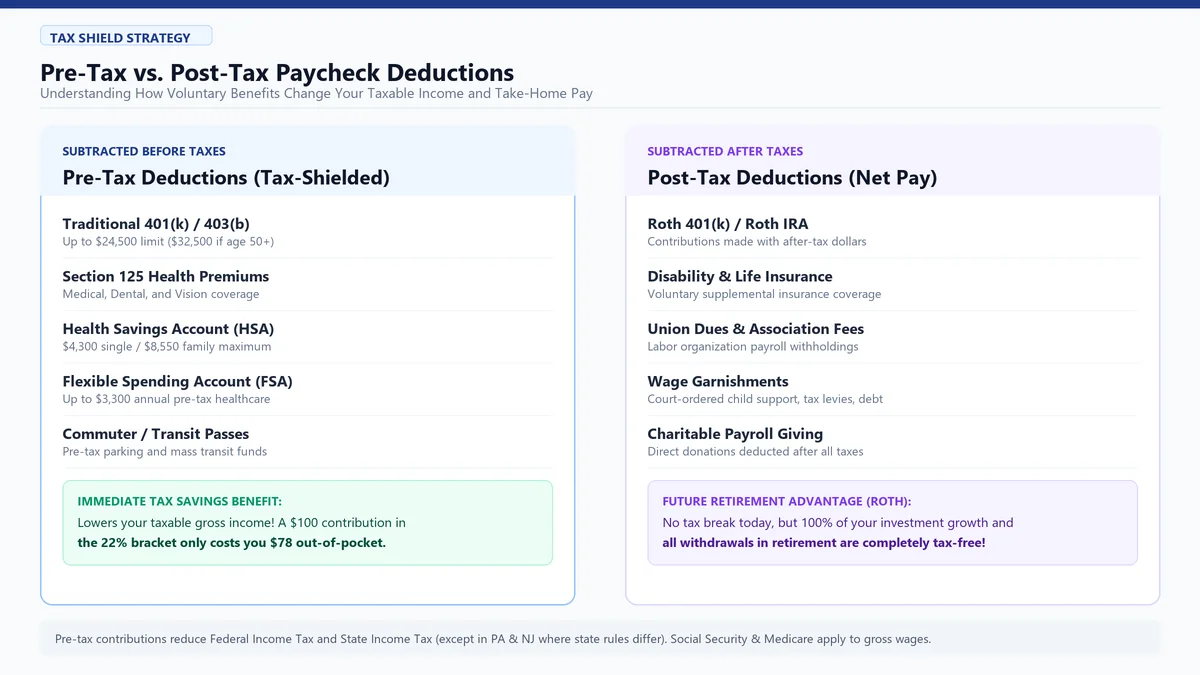
Similar to Social Security tax, only specific pre-tax deductions exempt earnings from Medicare tax:
- Section 125 Pre-Tax Deductions DO Reduce Medicare Tax: Health, dental, and vision insurance premiums, Health Savings Account (HSA) contributions, and Healthcare FSAs lower your Medicare taxable wages. For every $1,000 in Section 125 deductions, you save $14.50 in Medicare tax.
- Traditional 401(k) Does NOT Reduce Medicare Tax: 401(k) and 403(b) retirement contributions reduce income tax only, remaining fully subject to Medicare tax.
Marriage Penalty & Tax Refund Reconciliation on Additional Medicare Tax
Because employers withhold Additional Medicare Tax at the individual $200,000 threshold, married couples often experience withholding discrepancies:
- The Two-Earner Shortfall: Spouse A earns $150,000 and Spouse B earns $150,000 ($300,000 combined). Neither employer withholds the 0.9% tax because neither single wage exceeds $200,000. However, on their joint tax return, they owe 0.9% on the $50,000 excess over $250,000 ($450 tax due on IRS Form 8959).
- The Single-Earner Overpayment: If one spouse earns $220,000 and the other earns $0, the employer withholds 0.9% on $20,000 ($180). On their joint return, total income ($220,000) is below the $250,000 joint threshold, so the $180 is fully refunded.
Additional Medicare Tax Explained
The extra 0.9% applies to wages above $200,000 no matter your filing status, at the point your employer withholds. On your return the threshold depends on status: $250,000 for joint filers and $125,000 for separate filers. If your spouse also earns and your combined wages exceed $250,000, you may owe more than was withheld. Form 8959 settles the difference.
Medicare Tax for Hourly and Part-Time Workers
There is no minimum wage below which Medicare tax stops. A $12 per hour part-time worker still pays 1.45%, which is $0.17 on each hour before overtime. The same rate applies to tips and bonuses.
How Medicare Tax Fits With Medicare Premiums
Medicare tax is separate from the premiums you may pay for Part B or Part D after age 65. The payroll tax funds the hospital insurance trust fund during your working years and does not buy a specific plan.
Frequently Asked Questions
What is the standard Medicare tax rate on paychecks in 2026?
The standard employee Medicare tax rate is 1.45% on 100% of gross earnings with no annual wage cap. Employers match this with an additional 1.45%.
When does the 0.9% Additional Medicare Tax apply?
The Additional Medicare Tax of 0.9% applies to wages exceeding $200,000 for single filers and $250,000 for married couples filing jointly, bringing the employee rate to 2.35%.
Does Medicare tax ever stop like Social Security tax?
No. Medicare tax has no wage cap. It is deducted from every dollar of compensation earned throughout your entire career.
Does my employer match the Additional 0.9% Medicare Tax?
No. Employers only match the standard 1.45% Medicare tax. The additional 0.9% tax is paid entirely by the employee.
How do married couples reconcile Additional Medicare Tax?
Married couples file IRS Form 8959 with their Form 1040 tax return to calculate the combined liability against the $250,000 threshold and reconcile any overwithholding or underwithholding.
Do HSA contributions reduce Medicare taxes?
Yes. HSA contributions made through employer payroll deduction under a Section 125 Cafeteria plan are exempt from both Medicare tax (1.45%) and Social Security tax (6.2%).
How these numbers are figured: 2026 IRS withholding rules (Publication 15-T) and state figures last verified September 2026. Results are estimates. Read the full methodology and sources.