Paycheck Withholding Explained: How It Works
What paycheck withholding is, how employers calculate deductions under IRS rules in 2026, and how to optimize withholding to avoid tax penalties or huge refunds.
Paycheck withholding is the statutory mechanism through which employers deduct income taxes and payroll contributions from employee wages on a pay-as-you-go basis. In 2026, understanding your withholding ensures you do not give the IRS an interest-free loan through a massive refund or face surprise tax bills and underpayment penalties.

How Paycheck Tax Withholding Works Under IRS Rules
Federal and state governments operate on a pay-as-you-go tax system. Rather than paying your entire annual tax bill in a lump sum on April 15, federal law (IRC Section 3402) requires employers to withhold estimated taxes from each paycheck and remit them to the IRS and state treasuries throughout the year.
Each paycheck is evaluated independently using IRS Publication 15-T percentage tables. The withholding calculation factors in your taxable earnings, pay frequency, filing status, and specific Form W-4 elections.
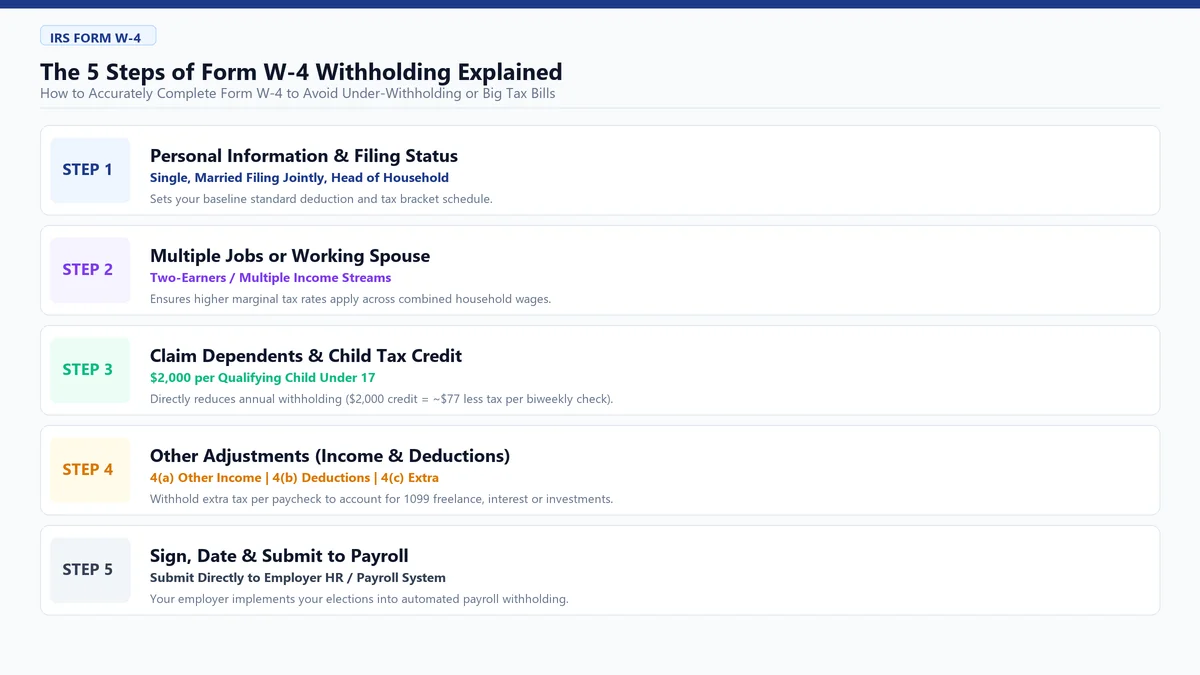
The 4 Variables That Dictate Your Withholding Amount
Your exact paycheck withholding is governed by four primary variables:
- Taxable Gross Wages: Your total gross compensation minus pre-tax deductions (traditional 401(k), Section 125 health insurance, HSA, and FSA contributions).
- Payroll Frequency: Whether your employer distributes pay on a weekly (52), biweekly (26), semimonthly (24), or monthly (12) schedule.
- IRS Form W-4 Elections: Your chosen filing status, number of qualifying dependents (Step 3), other non-wage income (Step 4a), itemized deductions (Step 4b), and extra per-paycheck withholding (Step 4c).
- State Withholding Certificates: State-specific tax declarations (e.g., California DE-4, New York IT-2104, Illinois W-4) governing state and municipal withholding.
Tax Refund vs Tax Balance Due: Achieving Zero-Liability Balance
Optimizing your paycheck withholding means aiming for a near-zero tax balance at filing time:
| Outcome | What It Means | Financial Impact |
|---|---|---|
| Large Tax Refund (>$3,000) | You significantly over-withheld taxes on each paycheck throughout the year. | You gave the government an interest-free loan of $250+ per month that could have paid down debt or earned 4-5% in a high-yield savings account. |
| Large Tax Bill Due (>$1,000) | You under-withheld taxes during the year. | You must pay a lump sum in April and may incur IRS underpayment penalties if withholding was below safe-harbor minimums. |
| Optimized (±$200) | Your paycheck withholding closely matches your true annual tax liability. | Maximum cash flow in every paycheck with zero surprise penalties or liquidity crunches at tax filing time. |

When and Why You Should Update Your Paycheck Withholding
You should submit a revised Form W-4 to your employer whenever you experience major life or financial milestones:
- Marriage or Divorce: Combining incomes or switching to single filing status dramatically alters your tax brackets.
- Birth or Adoption of a Child: Qualifies you for the $2,000 Child Tax Credit in Step 3, immediately reducing withholding by $76.92 per biweekly paycheck.
- Purchasing a Home: Substantial mortgage interest and property taxes may allow you to itemize deductions in Step 4(b), reducing paycheck withholding.
- Second Job or Spouse Entering Workforce: Triggers the two-earner household bracket bump; requiring Step 2 checkbox or Step 4(c) extra withholding.
- Significant Non-Wage Income: Capital gains, rental income, or freelance 1099 earnings can be offset by adding extra withholding in Step 4(c).
How Bonuses, Commissions & Supplemental Wages Are Withheld
Supplemental wages — including bonuses, commissions, and severance — are withheld using specific statutory IRS methods:
- Flat 22% Federal Rate: For supplemental wages up to $1,000,000 paid separately from regular wages, employers withhold a flat 22% federal tax (plus 7.65% FICA and state tax).
- Aggregate Withholding Method: If supplemental pay is lumped into regular wages without itemizing, payroll software treats the combined sum as regular pay, which often withholds at a higher marginal bracket for that specific pay period.
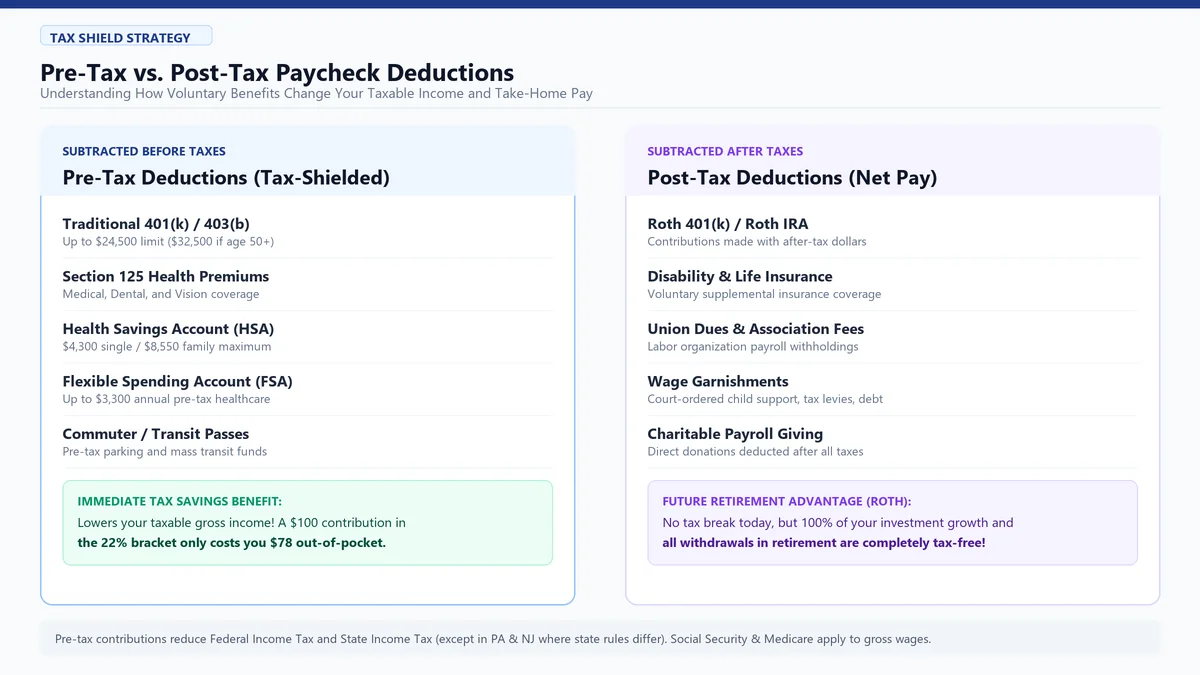
Worked Example: Fixing a Big Refund
Suppose you received a $2,600 refund last year. Dividing by 26 biweekly checks shows you overpaid about $100 per paycheck. Updating your W-4 so withholding drops by roughly that amount puts about $100 in each check instead of one lump sum in spring. Ask your payroll department to update your W-4 entries, then run the calculator with your new filing status, children and deductions to confirm the new take-home amount.
Withholding for a Second Job
If you hold two jobs, each employer assumes it is your only one and applies the standard deduction to each. That double-counts the deduction and under-withholds. Check the W-4 Step 2 box on both jobs or use the IRS estimator so the total tax matches your real bill.
Estimated Taxes for Side Income
Freelance or side-business income has no withholding. Either increase W-4 withholding at your main job or pay quarterly estimated taxes. Failing to prepay can trigger an underpayment penalty even if you pay in full when you file.
How Bonuses Are Withheld
Bonuses, commissions and back pay are supplemental wages. Your employer may withhold federal tax on them in two ways:
- Flat percentage method. When the bonus is paid on a separate check, 22% federal withholding is common (37% on supplemental wages above $1 million in a year).
- Aggregate method. When the bonus is added to a regular paycheck, the combined amount is withheld as if it were one large paycheck under your W-4, which can look like a much higher bracket.
Neither method is your final tax. Your real tax on the bonus depends on your bracket, and any over-withholding comes back as a refund when you file. Social Security and Medicare apply on top, and most states withhold their own tax.
| Bonus | Withheld at 22% | Actual federal tax | Social Security + Medicare | You keep |
|---|---|---|---|---|
| $1,000 | $220 | $220 | $76 | $704 |
| $5,000 | $1,100 | $1,100 | $382 | $3,518 |
| $10,000 | $2,200 | $2,200 | $765 | $7,035 |
| $25,000 | $5,500 | $5,500 | $1,912 | $17,588 |
Single filer earning $75,000 in Texas (no state tax). "Withheld at 22%" is what a flat-rate check would take; "Actual federal tax" is the extra tax you truly owe on the bonus. At this salary every bonus dollar lands in the 22% bracket, so flat withholding matches. Lower earners are over-withheld and get the difference back at filing; earners whose bonus pushes them into the 24% bracket or higher can be under-withheld.
Bonus and Supplemental Wage Withholding
Bonuses use the flat 22% or aggregate method. See how bonuses are taxed for worked examples.
Frequently Asked Questions
What is paycheck withholding?
Paycheck withholding is the amount an employer deducts from your gross pay to cover federal, state, and local income taxes, as well as mandatory FICA taxes (Social Security and Medicare).
How do I change my paycheck withholding?
Submit an updated IRS Form W-4 (and corresponding state withholding form) to your company’s HR or payroll department or update it directly in your online employee payroll portal.
Why is getting a large tax refund a bad financial strategy?
A large refund means you overpaid taxes each month, effectively giving the federal government an interest-free loan rather than investing that money or using it to pay off high-interest debt.
What is the IRS safe harbor rule for withholding?
To avoid underpayment penalties, you must withhold at least 90% of your current year’s tax liability or 100% of your prior year’s liability (110% if your prior year AGI exceeded $150,000).
How does Form W-4 Step 4(c) extra withholding work?
Step 4(c) allows you to specify an exact additional dollar amount (e.g., $50 or $100) to be deducted from each paycheck and credited toward your federal income tax.
Do bonuses get taxed higher than regular paychecks?
Bonuses are withheld at a flat 22% federal rate, which may feel higher, but they are ultimately taxed as ordinary income at your regular marginal tax bracket when you file Form 1040.
How these numbers are figured: 2026 IRS withholding rules (Publication 15-T) and state figures last verified September 2026. Results are estimates. Read the full methodology and sources.