Monthly Paycheck Calculator
Monthly pay means receiving 12 paychecks per calendar year, typically on the last business day or first day of each month. Enter your annual salary or monthly gross rate below to calculate your exact monthly gross pay, pre-tax benefit deductions, 2026 federal withholding, FICA taxes, state taxes, and net take-home deposit per month.
How to Use the Monthly Paycheck Calculator
- Enter your yearly salary.
- Keep pay frequency on Monthly (12 per year).
- Choose your state and filing status.
- Add benefits under More options, then read your monthly take-home.

How Monthly Pay Is Calculated (Step-By-Step Gross-To-Net Waterfall)
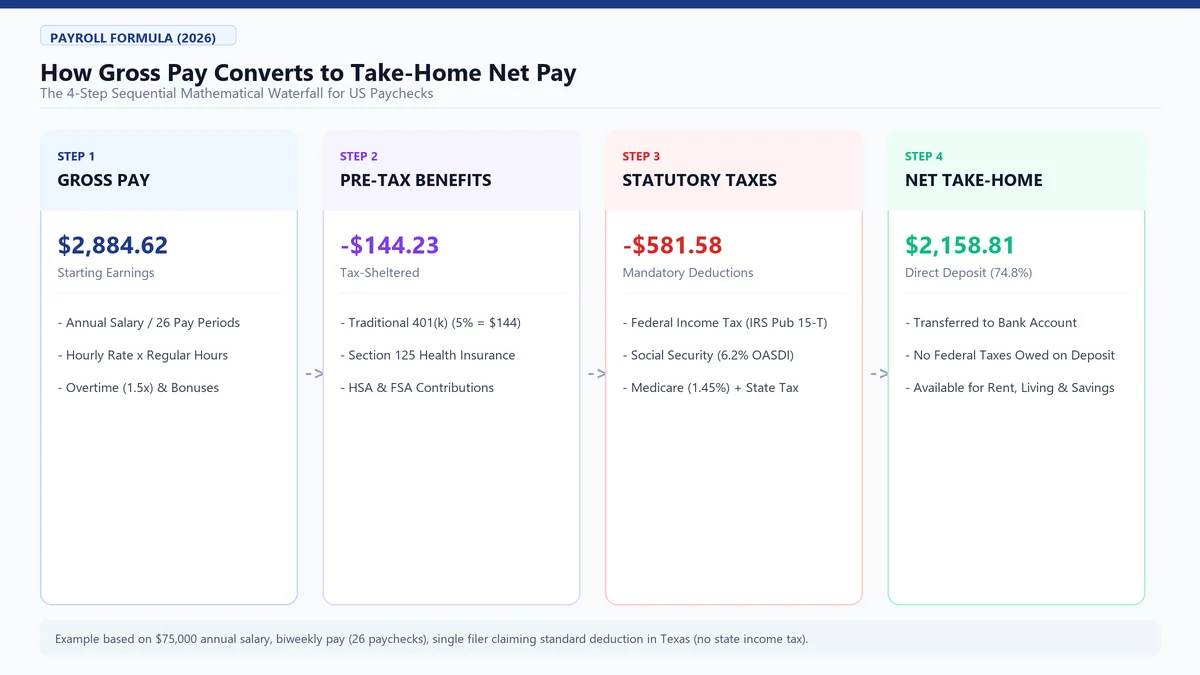
Monthly payroll consolidates compensation into 12 pay periods per year. Calculating net monthly take-home pay follows a four-step gross-to-net waterfall:
- Step 1: Calculate Monthly Gross Pay
For salaried personnel, divide your annual gross salary by 12:Monthly Gross Pay = Annual Base Salary / 12For hourly workers, multiply your regular hourly wage by the standard monthly working hours average (173.33 hours for full-time 40-hour workweeks):Monthly Gross Pay = Hourly Rate × 173.33 Hours - Step 2: Deduct Monthly Pre-Tax Benefits
Subtract pre-tax benefits allocated across 12 monthly cycles (traditional 401(k)/403(b), Section 125 medical/dental/vision insurance premiums, HSA, and healthcare FSA elections). This yields your federal and state taxable wage base. - Step 3: Calculate Mandatory Tax Withholdings
Apply IRS and state monthly percentage tables:- Federal Income Tax (FIT): Computed via IRS Publication 15-T monthly withholding tables according to your Form W-4 filing status.
- Social Security (OASDI): 6.2% on monthly gross earnings up to the 2026 cap of $184,500 (or $15,375.00/month maximum taxable base).
- Medicare: 1.45% on all compensation without limit, plus 0.9% Additional Medicare Tax on cumulative earnings over $200,000 for single filers ($250,000 married).
- State & Local Taxes (SIT/LIT): Deducted based on state-specific progressive brackets or flat tax rates.
- Step 4: Subtract Post-Tax Deductions
Subtract post-tax deductions (Roth 401(k), voluntary life insurance, union dues, garnishments) to arrive at your Net Monthly Take-Home Pay.
Mastering the 50/30/20 Budget on a Single Monthly Paycheck
Receiving your entire compensation in one single monthly deposit requires disciplined cash management to prevent end-of-month cash crunches. The 50/30/20 budgeting rule provides an ideal framework:
- 50% for Essential Needs (Fixed Obligations): Transfer 50% of your net monthly paycheck immediately on Payday 1 into a dedicated “Bills Checking Account.” This covers rent/mortgage, utilities, auto loans, insurance premiums, debt minimums, and core groceries.
- 20% for Wealth Accumulation (Savings & Debt Paydown): Automate a 20% transfer on Payday 1 into high-yield savings accounts (emergency fund), Roth IRAs, or extra principal payments on high-interest loans.
- 30% for Flexible Spending (Discretionary Lifestyle): Divide the remaining 30% into four equal weekly spending buckets (or transfer 1/4th each Friday into a spending debit account) for dining out, entertainment, shopping, and hobbies.
Overcoming the First-Month Paycheck Delay (the 30-to-45 Day Onboarding Gap)
When transitioning to a new employer with monthly payroll, new hires frequently experience an extended payment delay:
- The Lag Window: If you start work on the 2nd of the month, payroll cutoff rules may prevent processing until the end of the subsequent month — creating a 30 to 45-day gap before your first deposit arrives.
- Building a Transition Buffer: Maintain at least 1.5 months of living expenses in an accessible cash buffer before switching to a monthly payroll position.
- Synchronizing Due Dates: Contact creditors, landlords, and utility providers to align your recurring monthly bill payment dates with your direct deposit date (e.g., 3rd or 5th of each month).
2026 Statutory Pre-Tax Contribution Limits per Monthly Paycheck
To maximize annual tax savings across 12 monthly pay periods in 2026, set your monthly pre-tax deductions to the following IRS statutory limits:
| Account Type | 2026 Annual Statutory Limit | Max Per Monthly Check (12 Checks) |
|---|---|---|
| Traditional 401(k) / 403(b) (Under 50) | $24,500 | $2,041.67 / month |
| 401(k) / 403(b) Catch-Up (Age 50+) | $32,500 ($24,500 + $8,000) | $2,708.33 / month |
| Health Savings Account (HSA) — Individual | $4,400 | $366.67 / month |
| Health Savings Account (HSA) — Family | $8,750 | $729.17 / month |
| Healthcare Flexible Spending Account (FSA) | $3,400 | $283.33 / month |
| Commuter / Qualified Transit Benefits | $3,900 ($325/mo) | $325.00 / month |

Monthly Paycheck Conversion & Salary Benchmark Table
The table below shows monthly gross earnings across annual salaries and estimated net monthly take-home pay in a state with no income tax (Texas):
| Annual Gross Salary | Monthly Gross Pay (12 checks) | Equivalent Hourly Rate (2,080 hrs) | Est. Net Monthly Pay (TX / 0% Tax)* |
|---|---|---|---|
| $48,000 / yr | $4,000.00 | $23.08 / hr | $3,310 / month |
| $60,000 / yr | $5,000.00 | $28.85 / hr | $4,082 / month |
| $75,000 / yr | $6,250.00 | $36.06 / hr | $5,051 / month |
| $100,000 / yr | $8,333.33 | $48.08 / hr | $6,554 / month |
| $120,000 / yr | $10,000.00 | $57.69 / hr | $7,754 / month |
| $150,000 / yr | $12,500.00 | $72.12 / hr | $9,284 / month |
*Estimated monthly net pay based on 2026 single filer standard deduction with no pre-tax benefits in Texas (0% SIT). Use the interactive calculator above for custom numbers.
Multi-State Monthly Take-Home Comparison ($8,000 Gross / $96,000 Annual)
State and local taxes have a substantial impact on monthly cash flow. The table below compares a $8,000 monthly gross paycheck ($96,000 annual salary) across different state tax environments:
| State | Monthly Gross | Federal + FICA Tax | State & Local Tax | Net Monthly Pay | Annual Net Difference vs TX |
|---|---|---|---|---|---|
| Texas / Florida (0% SIT) | $8,000.00 | $1,686.20 | $0.00 | $6,313.80 | Baseline ($0) |
| Illinois (4.95% Flat SIT) | $8,000.00 | $1,686.20 | $383.62 | $5,930.18 | -$4,603.44 / yr |
| California (Progressive + SDI) | $8,000.00 | $1,686.20 | $508.40 | $5,805.40 | -$6,100.80 / yr |
| New York City (NYS + NYC Local) | $8,000.00 | $1,686.20 | $684.50 | $5,629.30 | -$8,214.00 / yr |
Monthly Take-Home Pay by Annual Salary Benchmark
| Salary | Gross / pay | Net / pay | Net per year | Tax rate |
|---|---|---|---|---|
| $35,000 | $2,916.67 | $2,525.21 | $30,302 | 13.4% |
| $50,000 | $4,166.67 | $3,529.58 | $42,355 | 15.3% |
| $65,000 | $5,416.67 | $4,533.96 | $54,408 | 16.3% |
| $80,000 | $6,666.67 | $5,425.83 | $65,110 | 18.6% |
| $100,000 | $8,333.33 | $6,598.33 | $79,180 | 20.8% |
| $125,000 | $10,416.67 | $8,058.62 | $96,704 | 22.6% |
| $150,000 | $12,500.00 | $9,482.58 | $113,791 | 24.1% |
Figures assume 12 equal monthly paychecks, single filer, Texas (no state tax), claiming standard deductions with no pre-tax benefits.
How an Annual Bonus Changes Monthly Take-Home
A bonus paid in one month makes the deposit for that month larger, and it is often withheld at the statutory supplemental 22% federal rate rather than regular bracket withholding. See our tax guide for supplemental withholding details.
Example Scenarios
A $60,000 salary is $5,000 gross monthly, $80,000 is $6,666.67 and $120,000 is $10,000. With state tax, a 401(k) and health insurance, monthly take-home is typically 65% to 80% of gross. Add your own deductions to see where you land.
Frequently Asked Questions
How do I convert annual salary to monthly pay?
Divide your annual gross salary by 12. For example, an $84,000 annual salary divided by 12 equals $7,000.00 monthly gross pay before taxes and benefit deductions.
How is monthly pay calculated from an hourly rate?
Assuming a full-time 40-hour workweek across 2,080 annual working hours, multiply your hourly wage by 173.33 hours (2,080 / 12). For example, $30.00/hour × 173.33 = $5,200.00 monthly gross pay.
What is the best way to budget on a monthly paycheck?
Use the 50/30/20 rule: on Payday 1, allocate 50% immediately to fixed obligations (rent, debt, utilities), 20% to automated savings and investments, and divide the remaining 30% into four weekly spending envelopes to ensure funds last all month.
What is the difference between monthly and semimonthly pay?
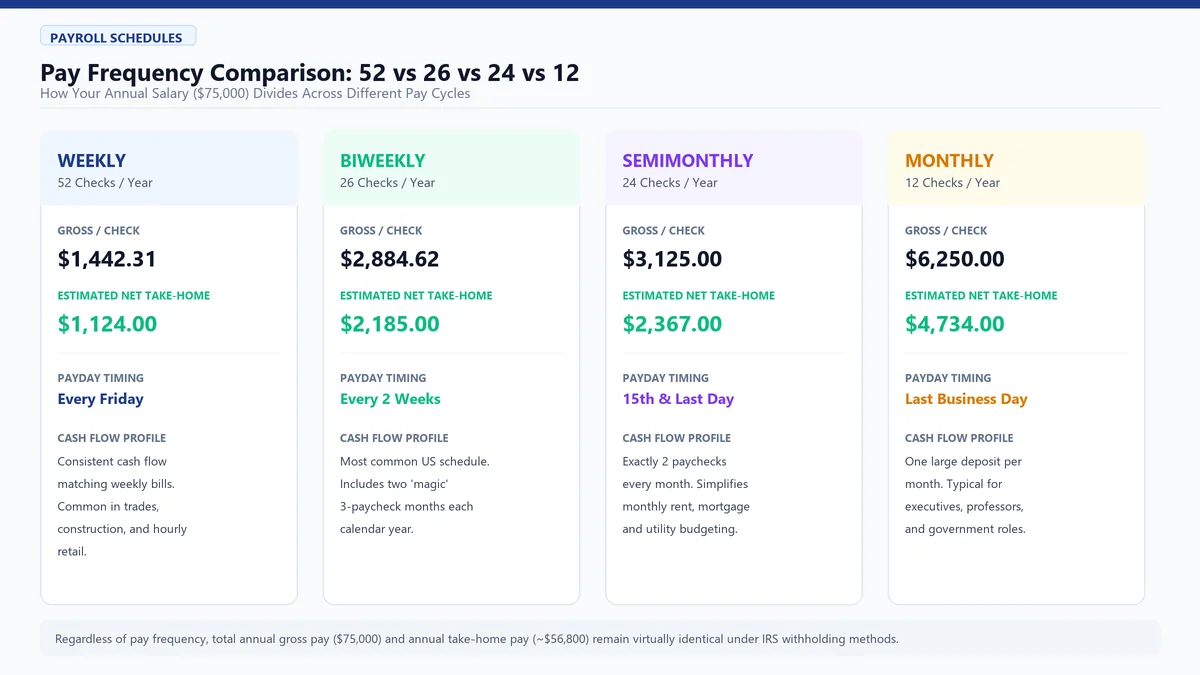
Monthly payroll pays once per month (12 paychecks per year). Semimonthly payroll pays twice per month (24 paychecks per year, typically on the 15th and last day). Monthly paychecks are exactly twice as large as semimonthly paychecks for the same salary.
How much can I contribute to my 401(k) per month in 2026?
Under 2026 IRS rules, the elective deferral limit is $24,500. Divided by 12 months, you can contribute up to $2,041.67 per month (or $2,708.33/month if age 50 or older).
Why is monthly payroll common in academia and government?
Monthly payroll minimizes administrative payroll processing fees for large institutions, aligns cleanly with monthly municipal accounting cycles, and suits salaried professional roles with predictable annual contracts.
How accurate is the monthly paycheck calculator?
It divides your annual pay into 12 equal payments. Benefit costs billed per pay period, or a bonus paid in one month, will make a real month differ.
Do I pay more tax if I am paid monthly?
No. Annual tax depends on annual income. Monthly pay just concentrates withholding into fewer, larger paychecks.
How these numbers are figured: 2026 IRS withholding rules (Publication 15-T) and state figures last verified September 2026. Results are estimates. Read the full methodology and sources.
Related Calculators and Guides
Want a state-specific result? Try California, Texas, New York, Florida.
or see all state calculators.