Salary Paycheck Calculator
Convert your annual base salary into exact net take-home pay per paycheck. Choose your pay frequency (weekly, biweekly, semimonthly, monthly), state, filing status, and pre-tax deductions to calculate 2026 federal withholding, FICA payroll taxes, and state income tax across all 50 states and DC.
How to Use the Salary Paycheck Calculator
- Choose Salary and enter your yearly pay.
- Select pay frequency and state.
- Open More options to add filing status, children, pre-tax deductions and a bonus.
- Compare the result with a pay stub or an offer letter.

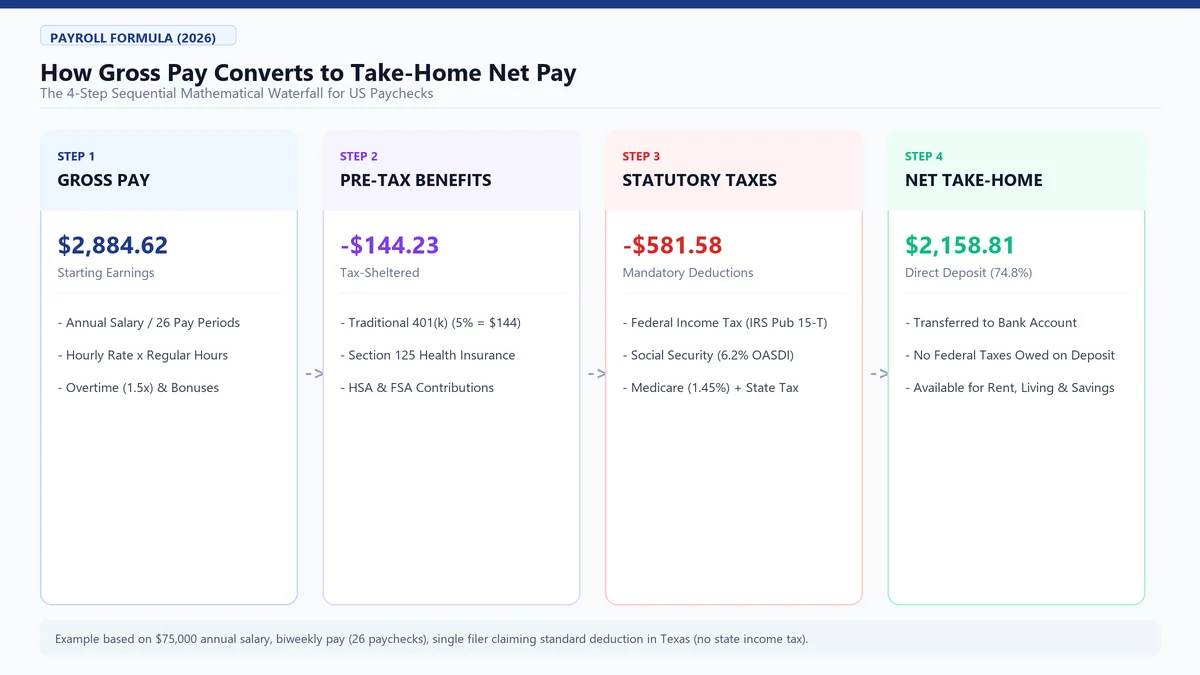
How the Salary Calculation Works: The 4-step Gross-To-Net Formula
To calculate net take-home pay from an annual salary, divide your gross salary by your annual pay cycles (e.g., 26 for biweekly, 24 for semimonthly, 12 for monthly), subtract pre-tax deductions (like traditional 401(k) or health premiums), and then deduct federal income tax, FICA payroll taxes (6.2% Social Security and 1.45% Medicare), and applicable state and local income taxes.
Net Pay per Check = (Annual Salary / Pay Cycles) - Pre-Tax Deductions - Federal Tax - FICA (7.65%) - State/Local Taxes
Example: a $75,000 salary paid biweekly in Texas is $2,884.62 gross and about $2,368.94 net per paycheck, roughly $61,592 a year.
Salary to Hourly Wage Conversion Matrix (2,080-hour Standard)
A standard full-time work year consists of 2,080 hours (40 hours per week × 52 weeks). Here is how common annual salaries convert across common pay periods before taxes:
| Annual Salary | Hourly Equivalent | Weekly (52 checks) | Biweekly (26 checks) | Monthly (12 checks) |
|---|---|---|---|---|
| $50,000 / yr | $24.04 / hr | $961.54 | $1,923.08 | $4,166.67 |
| $65,000 / yr | $31.25 / hr | $1,250.00 | $2,500.00 | $5,416.67 |
| $75,000 / yr | $36.06 / hr | $1,442.31 | $2,884.62 | $6,250.00 |
| $90,000 / yr | $43.27 / hr | $1,730.77 | $3,461.54 | $7,500.00 |
| $100,000 / yr | $48.08 / hr | $1,923.08 | $3,846.15 | $8,333.33 |
| $125,000 / yr | $60.10 / hr | $2,403.85 | $4,807.69 | $10,416.67 |
| $150,000 / yr | $72.12 / hr | $2,884.62 | $5,769.23 | $12,500.00 |
Salary vs Take-Home Pay: Why You Keep 70% to 85% of Gross
Take-home pay typically ranges between 70% and 85% of gross salary for most US workers. The difference is driven by three main factors: progressive federal income tax brackets (10% to 37%), 7.65% mandatory FICA contributions, and state income taxes (which range from 0% in nine states to over 10% in high-tax jurisdictions). Learn more in gross pay vs net pay.
The Same $75,000 Salary Across Three States (TX vs. CA vs. NY)
Because federal income tax and FICA taxes are identical nationwide, state income taxes and state payroll programs drive the entire difference in take-home pay:
| State / Filing Profile | Annual Gross | Federal Tax | FICA (7.65%) | State Income Tax | Net Pay (Biweekly) | Annual Take-Home |
|---|---|---|---|---|---|---|
| Texas (No State Tax) | $75,000 | $7,951 | $5,738 | $0 | $2,358.12 | $61,311 |
| California (Progressive + CASDI) | $75,000 | $7,951 | $5,738 | $2,798 | $2,250.50 | $58,513 |
| New York (State + NYC Tax) | $75,000 | $7,951 | $5,738 | $3,426 | $2,226.35 | $57,885 |

2026 Statutory Pre-Tax Deduction Limits
- 401(k) / 403(b) Employee Deferral: $24,500 maximum elective deferral limit (plus $8,000 catch-up for age 50+, or $11,250 for ages 60–63).
- Health Savings Account (HSA): $4,400 for self-only coverage, $8,750 for family coverage (pre-tax for federal and FICA).
- Healthcare FSA: $3,400 maximum annual election.
Evaluating Job Offers, Annual Bonuses, and Pay Raises
- Evaluate Net Pay, Not Gross: A $10,000 raise in a 22% federal bracket leaves about $7,035 in net pay in Texas, but significantly less in California or New York once state taxes apply.
- Account for Supplemental Bonus Withholding: Bonuses are typically subject to a flat 22% federal withholding rate upfront, but reconcile against your actual marginal tax bracket when filing your return.
- High-Earner Social Security Cap Relief: Salaried workers earning over $184,500 stop paying the 6.2% Social Security tax once year-to-date earnings hit the limit, giving high earners a 6.2% net pay bump late in the calendar year.
Take-Home Pay by Salary Benchmark ($40k to $150k)
| Salary | Gross / pay | Net / pay | Net per year | Tax rate |
|---|---|---|---|---|
| $35,000 | $1,346.15 | $1,165.48 | $30,302 | 13.4% |
| $50,000 | $1,923.08 | $1,629.04 | $42,355 | 15.3% |
| $65,000 | $2,500.00 | $2,092.60 | $54,408 | 16.3% |
| $80,000 | $3,076.92 | $2,504.23 | $65,110 | 18.6% |
| $100,000 | $3,846.15 | $3,045.38 | $79,180 | 20.8% |
| $125,000 | $4,807.69 | $3,719.37 | $96,704 | 22.6% |
| $150,000 | $5,769.23 | $4,376.58 | $113,791 | 24.1% |
Biweekly pay, single filer, Texas (no state tax), claiming standard deductions. Select your home state in the calculator to apply local withholding schedules.
State-By-State Net Salary Comparison Table ($75,000 Benchmark)
| $75,000, biweekly, single | Gross | Net per check | Net per year | Tax rate |
|---|---|---|---|---|
| Texas | $2,884.62 | $2,368.94 | $61,592 | 17.9% |
| California | $2,884.62 | $2,224.22 | $57,830 | 22.9% |
| New York | $2,884.62 | $2,222.47 | $57,784 | 23% |
Federal income tax and FICA are identical nationwide. State income taxes and local payroll programs account for the entire gap in take-home pay between states.
What Raises Take-Home Pay Besides a Raise?
- Raise pre-tax contributions. Every $1,000 into a traditional 401(k), HSA or health FSA lowers taxable wages, so take-home falls by less than $1,000.
- Fix a large refund. If you get a refund every spring you are over-withholding. Update your W-4 so the money arrives in your paychecks instead.
- Claim credits you qualify for. Step 3 of the W-4 reduces withholding by $2,200 per qualifying child under 17.
- Check the second job. Two incomes without the W-4 Step 2 adjustment lead to under-withholding and a bill in April.
- Watch benefit elections in open enrollment. A cheaper health plan or a higher HSA election changes every paycheck.
Need a Target Take-Home Instead?
To work backwards from the net pay you want to the salary or gross bonus you need, read the net-to-gross guide.
Example Scenarios
A teacher at $58,000, an engineer at $95,000 and a manager at $130,000 all pay the same FICA rate up to the $184,500 wage base, but their federal brackets differ. The manager also crosses into the 24% bracket, so the last dollars are taxed harder. Enter each salary to compare.
Frequently Asked Questions
How much is $75,000 a year after taxes?
For a single filer in a no-income-tax state like Texas with no pre-tax deductions, a $75,000 salary yields approximately $2,368.94 per biweekly check, or roughly $61,592 per year in net take-home pay (~18.3% effective tax rate).
What does salary look like across different pay periods?
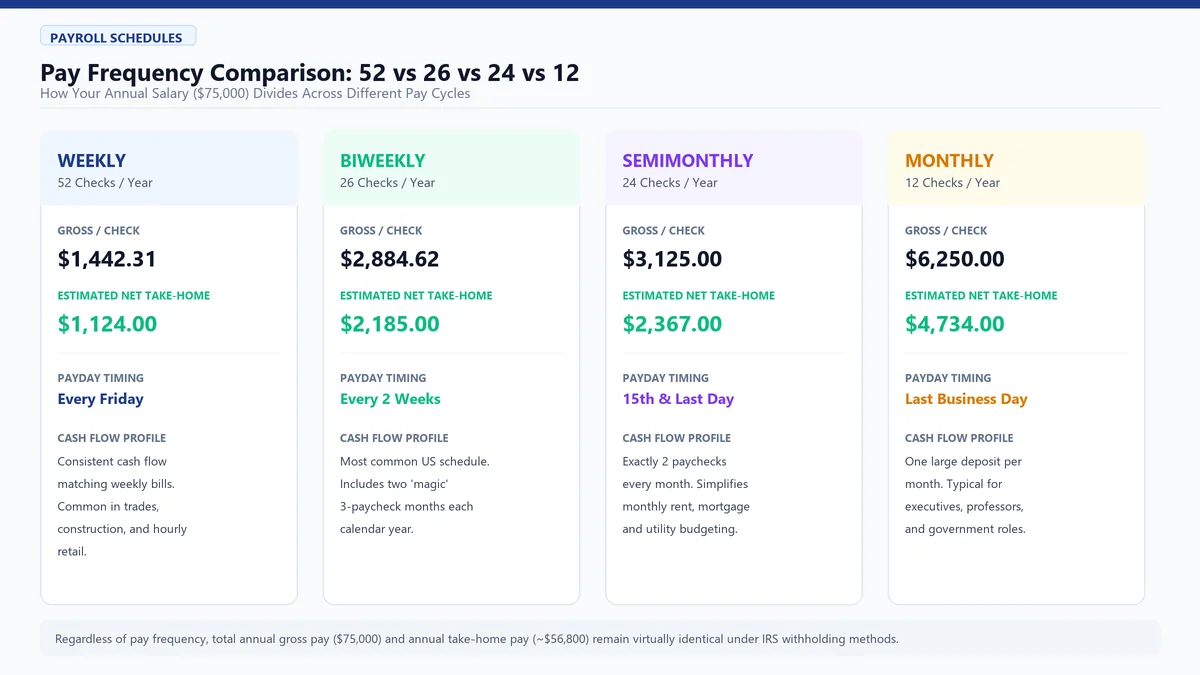
A $75,000 salary equals $6,250.00 gross per month (12 checks), $3,125.00 semimonthly (24 checks), $2,884.62 biweekly (26 checks), and $1,442.31 weekly (52 checks) before taxes.
How do pre-tax deductions lower my salary taxes?
Traditional 401(k), HSA, and Section 125 health insurance contributions reduce your taxable salary before federal and state taxes are calculated. If you contribute $500 pre-tax in the 22% bracket, your net paycheck only drops by $390 because you save $110 in taxes.
Does a bonus change the salary calculation?
Yes. Bonuses are supplemental wages typically withheld at a flat 22% federal rate. You can enter bonus amounts in the Annual Bonus field under More Options to see your adjusted annual take-home total.
When does Social Security tax stop for high-salary earners?
Social Security tax (6.2%) stops once your year-to-date wages reach the 2026 cap of $184,500. For example, a worker earning $250,000 will stop paying Social Security around paycheck 20 on a biweekly schedule, increasing subsequent net paychecks by 6.2%.
How accurate is the salary paycheck calculator?
It divides your salary evenly across pay periods and applies 2026 federal and state rules. Employer benefits, a bonus in one period or local taxes will change a real check. Use More options to add deductions.
Can I use it to compare two job offers?
Yes. Run each salary with the state where you would work and compare take-home per paycheck and per year. A higher salary in a state with income tax can leave less than a lower salary in one without.
How these numbers are figured: 2026 IRS withholding rules (Publication 15-T) and state figures last verified September 2026. Results are estimates. Read the full methodology and sources.
Related Calculators and Guides
Want a state-specific result? Try California, Texas, New York, Florida.
or see all state calculators.