Gross Pay vs Net Pay: What's the Difference?
Gross pay vs net take-home pay in 2026: the step-by-step conversion formula, pre-tax deductions, payroll taxes and real-world examples.
Gross pay is the total compensation you earn before any deductions or taxes are withheld. Net pay (commonly called take-home pay) is the actual cash deposited into your bank account. Understanding how to calculate and convert between gross and net pay is essential for personal budgeting, evaluating job offers, and qualifying for mortgages.

Gross Pay vs Net Pay: Direct Side-By-Side Comparison
The table below summarizes the key operational differences between gross pay and net pay for US employees:
| Feature | Gross Pay | Net Pay (Take-Home Pay) |
|---|---|---|
| Definition | Total wages earned before any taxes, benefits, or deductions are subtracted. | Final cash amount received via direct deposit or check after all deductions. |
| How It Is Stated | Job offer letters, employment contracts (e.g., “$85,000/year” or “$35.00/hour”). | Paystub bottom line, bank account direct deposit notification. |
| Used For | Mortgage applications, auto loans, Debt-to-Income (DTI) ratio calculations. | Monthly household budgeting, paying bills, living expenses, discretionary savings. |
| Components | Base pay + overtime + bonuses + commissions + tips + shift differentials. | Gross pay minus pre-tax deductions, payroll taxes (FIT, FICA, SIT), and post-tax items. |
| Percentage Kept | 100% of earned compensation. | Typically 68% to 85% of gross pay depending on state tax and benefit elections. |
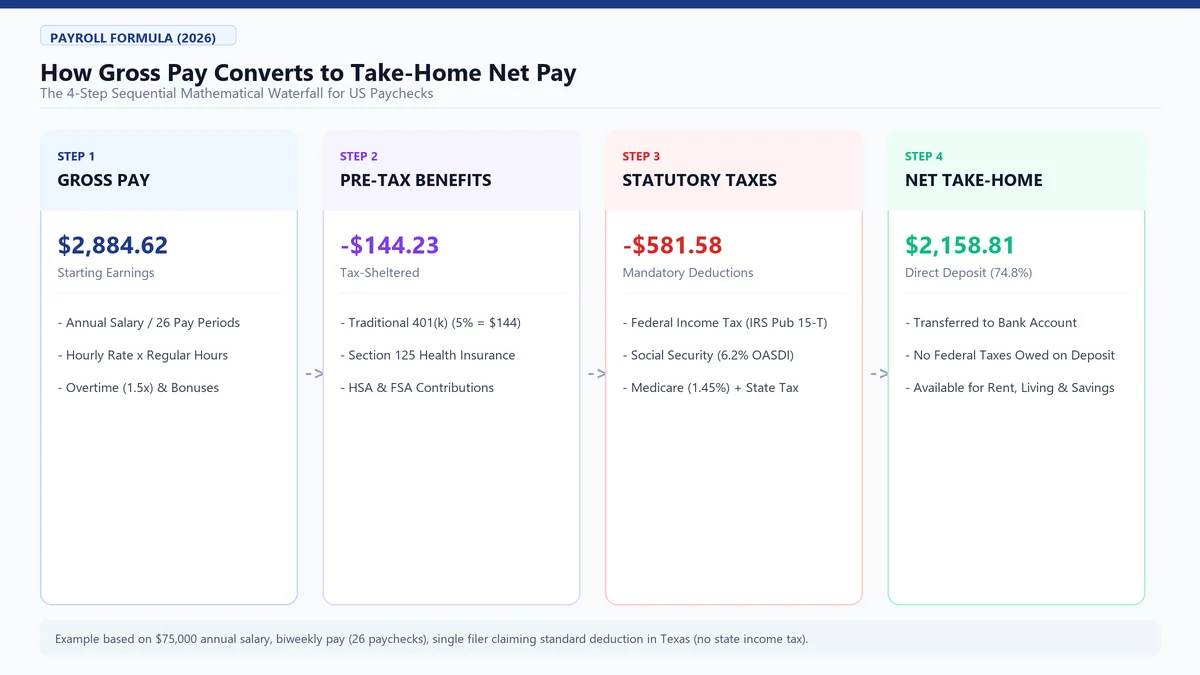
The Gross-To-Net Deduction Waterfall Formula
Converting gross pay into net take-home pay follows an exact statutory mathematical sequence:
- Start with Total Gross Pay: Sum all earnings (Regular Base Wage + Overtime + Bonuses + Commissions + Shift Differentials).
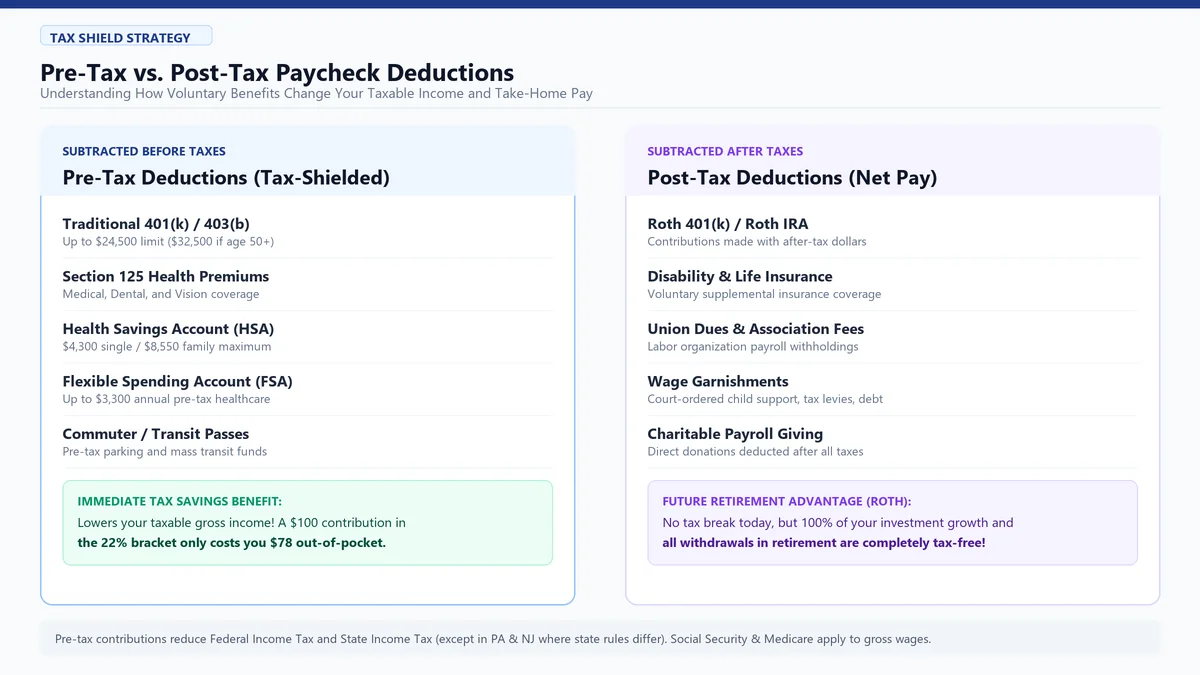
- Subtract Pre-Tax Deductions: Subtract Section 125 health/dental/vision insurance, HSA, healthcare FSA, and traditional 401(k)/403(b) retirement contributions. This determines your taxable gross wage base.
- Deduct Mandatory Statutory Payroll Taxes:
- Federal Income Tax (FIT): Withheld per IRS Publication 15-T and Form W-4.
- Social Security Tax (OASDI): 6.2% on gross earnings up to the 2026 cap of $184,500.
- Medicare Tax (HI): 1.45% on all earnings (+ 0.9% Additional Medicare above $200k single / $250k married).
- State & Local Income Taxes (SIT/LIT): Withheld per state and municipal tax brackets.
- State Disability / Paid Family Leave: Mandatory state insurance levies (e.g., CA SDI, NY PFL, NJ FLI).
- Subtract Post-Tax Deductions: Deduct Roth 401(k), voluntary life insurance, union dues, and court-ordered wage garnishments.
- Result = Net Take-Home Pay: The remaining balance transferred directly to your bank account on payday.
Comprehensive Conversion Matrix: Gross Salary to Net Take-Home Pay ($40k to $150k)
The table below provides a comprehensive gross-to-net conversion across standard US salary benchmarks for a single filer claiming standard deductions in a state with no income tax (Texas):
| Annual Gross Salary | Biweekly Gross (26 checks) | Federal Tax + FICA (Annual) | Est. Annual Net Pay | Est. Biweekly Net Pay | Effective Net % |
|---|---|---|---|---|---|
| $40,000 / yr | $1,538.46 | $5,486.00 | $34,514.00 | $1,327.46 / check | 86.3% |
| $60,000 / yr | $2,307.69 | $9,812.00 | $50,188.00 | $1,930.31 / check | 83.6% |
| $80,000 / yr | $3,076.92 | $15,116.00 | $64,884.00 | $2,495.54 / check | 81.1% |
| $100,000 / yr | $3,846.15 | $20,840.00 | $79,160.00 | $3,044.62 / check | 79.2% |
| $120,000 / yr | $4,615.38 | $26,944.00 | $93,056.00 | $3,579.08 / check | 77.5% |
| $150,000 / yr | $5,769.23 | $36,544.00 | $113,456.00 | $4,363.69 / check | 75.6% |

Which Number Should You Use? (Mortgage, Budgeting, Salary Negotiations)
Knowing whether to reference gross pay or net pay is critical in various financial contexts:
- Mortgage & Loan Applications (Use Gross Income): Mortgage underwriters and auto lenders evaluate your creditworthiness using Gross Monthly Income. They calculate your Debt-to-Income (DTI) ratio (monthly debt payments divided by gross monthly income), requiring a DTI generally below 43% for conventional conforming mortgages.
- Household Budgeting & Rent Affordability (Use Net Income): Always construct your living budget using Net Take-Home Pay. Basing your rent or mortgage on gross earnings will lead to severe cash flow shortages because 20% to 30% of your gross pay never reaches your bank account.
- Job Offer Evaluation (Evaluate Total Compensation): When evaluating competing job offers, compare not just the top-line gross salary, but the value of pre-tax health insurance subsidies, 401(k) employer matching percentages, and state income tax differences if relocating.
Why Your Net Take-Home Pay Fluctuates From Paycheck to Paycheck
Many employees notice unexpected changes in their net take-home pay over the course of the year. The primary drivers include:
- Variable Hours & Overtime: Hourly workers working differing weekly hours trigger fluctuating tax withholding due to annualized IRS withholding algorithms.
- Reaching the Social Security Wage Cap: High earners crossing $184,500 in 2026 experience an immediate +6.2% increase in net take-home pay once the OASDI tax turns off.
- Benefit Open Enrollment Changes: Annual increases in employer health insurance premiums or changes in your 401(k) contribution percentage alter your net paycheck.
- Tax Law & Standard Deduction Indexing: At the start of each January, IRS inflation adjustments to tax brackets and standard deductions slightly adjust net pay.
Checklist: Why Is My First or Current Paycheck Smaller Than Expected?
If your latest paycheck is smaller than anticipated, check the following common factors:
- Partial First Pay Period: If you started work mid-cycle, your first check only pays for the days worked between your start date and the end of the pay period.
- Payroll Arrears (Paid Behind): Many employers pay one week or two weeks in arrears. Your first check may arrive up to 3 to 4 weeks after your official start date.
- One-Time Benefit Deductions: Retroactive health insurance premiums or voluntary life insurance enrollments may double up on your initial paystub.
- State Disability Insurance / Local Taxes: Mandatory state programs (e.g., California 1.1% SDI, New York PFL) are deducted automatically in addition to federal taxes.
Gross-To-Net for Common Salaries
| $75,000, biweekly, single | Gross | Net per check | Net per year | Tax rate |
|---|---|---|---|---|
| Texas | $2,884.62 | $2,368.94 | $61,592 | 17.9% |
| California | $2,884.62 | $2,224.22 | $57,830 | 22.9% |
| New York | $2,884.62 | $2,222.47 | $57,784 | 23% |
The federal and FICA lines are identical in these three states. The difference is state income tax and state payroll programs, which is why the same gross salary can leave several hundred dollars less per year in California or New York than in Texas.
Gross vs Net When Comparing Job Offers
Compare offers on net pay in the state where you will actually work. A $5,000 higher salary is worth less if it comes with a state income tax, a longer commute or higher health premiums. Also count benefits that do not appear in gross pay: employer 401(k) match, HSA contributions, paid leave and equity.
Gross vs Net for Hourly Workers
For hourly workers, gross pay changes with hours. Estimate net pay at your lowest and highest realistic weekly hours. The hourly paycheck calculator and overtime paycheck calculator make that quick.
Why Is My Paycheck Smaller Than Expected?
If your paycheck is lower than you expected, check these in order:
- Gross versus net. Your offer letter quotes gross pay. Federal tax, Social Security and Medicare take about 20% before any state tax or benefits.
- Benefit deductions. Health, dental and vision premiums, HSA or FSA contributions and 401(k) deferrals all reduce net pay.
- State and local taxes. A state income tax, city wage tax or state disability and paid leave programs add lines that a simple estimate misses.
- A recent W-4 change. Fewer credits, a new filing status or extra withholding lowers every check.
- A partial pay period. The first check after you start, or after unpaid time off, covers only the days you worked.
- Year-to-date effects. Social Security stops at $184,500, so higher earners see checks grow late in the year. Some deductions, such as annual insurance premiums, are taken from certain checks only.
- Garnishments or after-tax deductions. Child support, wage garnishments, union dues and Roth contributions come out after tax.
Compare each line on your pay stub with the paycheck calculator. A gap of a few dollars is normal; a larger gap usually points to one of the items above.
Why Is My First Paycheck Smaller?
Your first check often covers only part of a pay period, and some employers pay one week behind, so the first deposit can arrive weeks after you start. Any one-time onboarding deductions or benefit enrollments that begin mid-period can also reduce it. From the second regular period on, your net pay should settle near the calculator estimate.
Working Backwards From Net to Gross
To find the gross pay needed for a specific take-home amount, use the net-to-gross guide. For how often you are paid, see pay frequency.
Frequently Asked Questions
What is the formula to convert gross pay to net pay?
The formula is: Net Pay = Gross Wages - Pre-Tax Benefits (401k, Health) - Federal Income Tax - Social Security (6.2%) - Medicare (1.45%) - State/Local Income Tax - Post-Tax Deductions.
How much is $60,000 gross salary after taxes?
For a single filer in a state with no income tax (Texas or Florida), a $60,000 gross salary yields approximately $50,188 per year in net take-home pay (about $1,930 biweekly). In California, net pay is roughly $47,600 ($1,830 biweekly) due to state taxes.
Do lenders look at gross or net income for mortgage approval?
Mortgage lenders evaluate Gross Monthly Income before taxes and deductions to calculate your Debt-to-Income (DTI) ratio. However, lenders also verify W-2s and tax returns to ensure stability of earnings.
Why does my net pay increase toward the end of the year?
If your gross earnings exceed $184,500 in 2026, Social Security tax (6.2%) stops being withheld once you reach this threshold. Your remaining paychecks for the year will be 6.2% larger.
Are bonuses taxed at a higher rate than regular gross pay?
Bonuses are withheld at a statutory flat federal rate of 22% (plus 7.65% FICA and state taxes), which may make the withholding appear higher. However, bonuses are taxed as ordinary income at your regular tax bracket when filing Form 1040.
How can I increase my net take-home pay without a raise?
You can increase take-home pay by updating your Form W-4 to claim eligible tax credits (avoiding excess withholding), reviewing health plan options during open enrollment, or utilizing pre-tax FSA/HSA accounts to lower taxable income.
How these numbers are figured: 2026 IRS withholding rules (Publication 15-T) and state figures last verified September 2026. Results are estimates. Read the full methodology and sources.