Paycheck Taxes Explained: What Comes Out of Your Paycheck
Plain-English guide to the taxes taken from a US paycheck in 2026: federal income tax, Social Security, Medicare, state income tax and local payroll taxes.
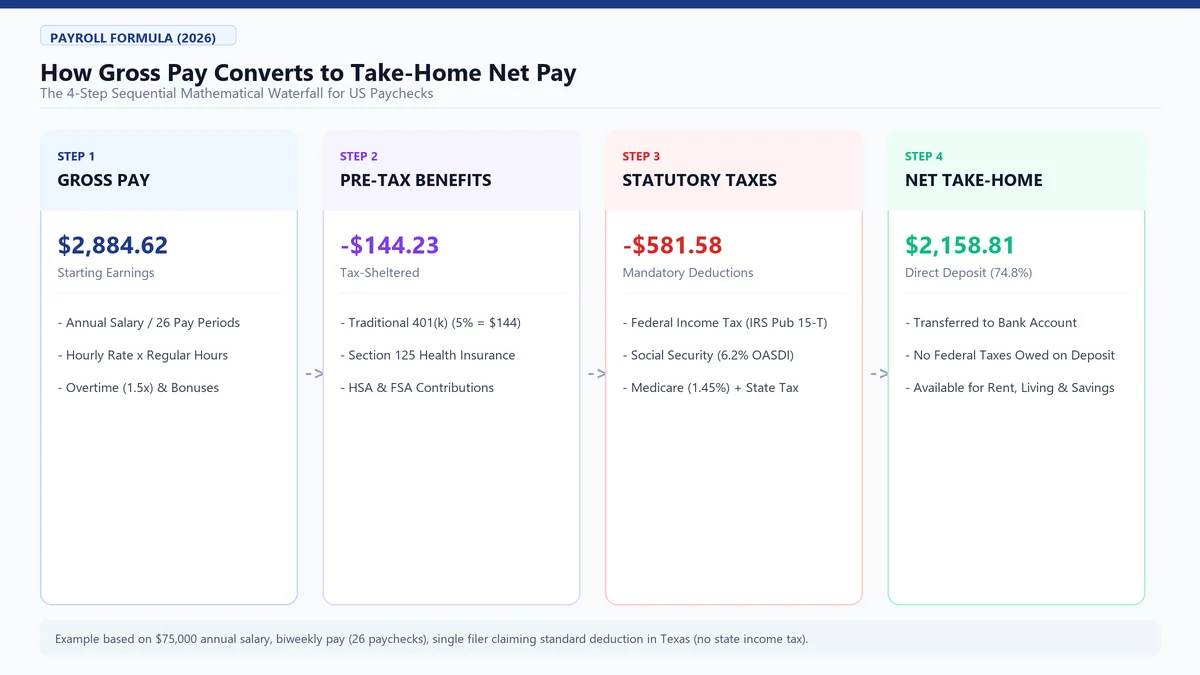
When you look at your paystub, the gap between what you earned (gross pay) and what was deposited in your bank account (net pay) is driven by mandatory statutory payroll taxes. Below is the complete, plain-English breakdown of every tax deducted from a US paycheck in 2026, how withholding is calculated under IRS rules, and how to optimize your net take-home pay.

The 5 Mandatory Taxes Deducted From a US Paycheck
Depending on where you live and work, up to five distinct government tax levies can be deducted from each paycheck:
| Tax Type | 2026 Statutory Rate | 2026 Wage Base Limit | Who Pays |
|---|---|---|---|
| Federal Income Tax (FIT) | Progressive (10% to 37%) | No limit (all taxable wages) | Employee (withheld via Form W-4) |
| Social Security (OASDI) | 6.2% | $184,500 (max $11,439.00/yr) | Employee + Employer match (6.2%) |
| Medicare (Hospital Insurance) | 1.45% (+ 0.9% over $200k) | No limit (uncapped) | Employee + Employer match (1.45%) |
| State Income Tax (SIT) | 0% to 13.3% (varies by state) | Varies by state statute | Employee (41 states + DC) |
| Local / Municipal Tax (LIT) | 0.5% to 3.876% (e.g., NYC, Philly) | Varies by municipality | Employee (select cities/counties) |
FICA Taxes Decoded: Social Security vs Medicare in 2026
The Federal Insurance Contributions Act (FICA) mandates payroll taxes that fund Social Security retirement/disability benefits and Medicare healthcare coverage for seniors:
- Social Security (OASDI): Employees pay a flat 6.2% on all gross earnings up to the 2026 statutory wage cap of $184,500. Your employer pays an identical 6.2% match (total 12.4%). Once cumulative earnings cross $184,500 in a calendar year, Social Security tax withholding stops entirely.
- Medicare (HI): Employees pay a flat 1.45% on 100% of gross earnings with no annual cap. Employers contribute a matching 1.45% (total 2.9%).
- Additional Medicare Tax: Under the Affordable Care Act (ACA), an additional 0.9% Medicare tax is withheld on earnings exceeding $200,000 for single filers ($250,000 for married couples filing jointly). Employers do not match this additional 0.9%.
State and Local Payroll Taxes: 0% States vs Progressive Income Tax States
State and local tax policies create substantial variation in take-home pay across the United States:
- The 9 States with No Individual Wage Income Tax: Alaska, Florida, Nevada, New Hampshire (interest/dividends only), South Dakota, Tennessee, Texas, Washington (capital gains only), and Wyoming. Workers in these states pay $0 in state wage withholding.
- Flat Tax States: States like Illinois (4.95%), Pennsylvania (3.07%), Indiana (3.05%), Colorado (4.40%), North Carolina (4.50%), and Utah (4.65%) apply a single flat tax percentage across all taxable wage levels.
- Progressive Tax States: States like California (1.0% to 13.3% + 1.1% SDI), New York (4.0% to 10.9%), Hawaii (up to 11.0%), and New Jersey (up to 10.75%) utilize graduated marginal tax brackets where higher earners pay higher rates.
- Local and City Income Taxes: Over 4,000 local jurisdictions in states like Pennsylvania, Ohio, New York (NYC Resident Tax up to 3.876%), Maryland (county taxes up to 3.20%), and Michigan (Detroit 2.4%) levy additional municipal income taxes.

Statutory Payroll Taxes vs Voluntary Pre-Tax & Post-Tax Deductions
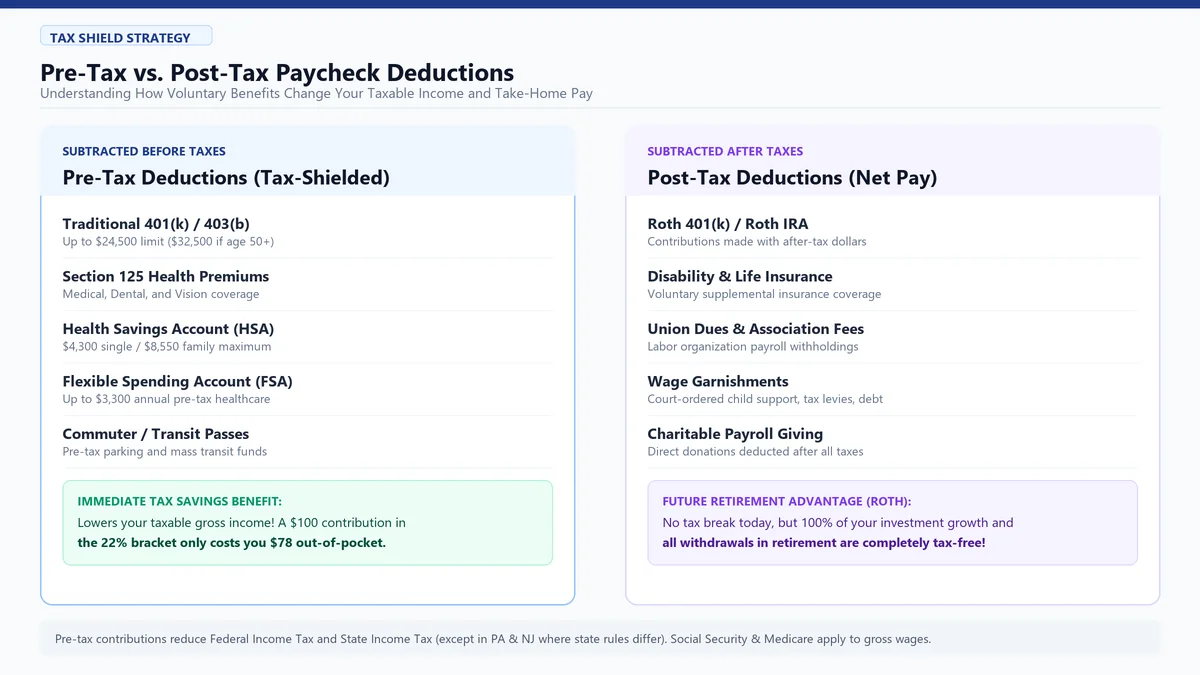
It is vital to distinguish between mandatory statutory taxes and voluntary employee benefit deductions:
| Category | Common Examples | Tax Impact on Paycheck |
|---|---|---|
| Pre-Tax Benefits (Section 125 / 401k) | Traditional 401(k), Medical/Dental/Vision premiums, HSA, Healthcare FSA | Reduces taxable gross wage base before Federal and State income taxes are calculated. Section 125 items also reduce FICA taxes. |
| Mandatory Statutory Taxes | Federal Income Tax, Social Security (6.2%), Medicare (1.45%), State Tax, Local Tax | Required by federal, state, and local statutes; remitted directly to government revenue agencies. |
| Post-Tax Deductions | Roth 401(k), voluntary life insurance, union dues, wage garnishments | Subtracted from net pay after all taxes are calculated. Does not reduce current-year taxable income. |
Step-By-Step Worked Paycheck Tax Example ($75,000 Biweekly Salary in TX vs CA)
The table below illustrates a detailed gross-to-net waterfall for an employee earning a $75,000 annual salary ($2,884.62 biweekly gross) claiming the standard single deduction with $200/check in 401(k) and $100/check in health insurance:
| Paycheck Line Item | Texas Worker (0% State Tax) | California Worker (Progressive SIT + SDI) |
|---|---|---|
| Biweekly Gross Salary | $2,884.62 | $2,884.62 |
| Less: Health Insurance (Section 125) | -$100.00 | -$100.00 |
| Less: Traditional 401(k) Contribution | -$200.00 | -$200.00 |
| Federal Taxable Wages | $2,584.62 | $2,584.62 |
| Federal Income Tax (FIT Withholding) | -$272.40 | -$272.40 |
| Social Security Tax (6.2% on $2,784.62) | -$172.65 | -$172.65 |
| Medicare Tax (1.45% on $2,784.62) | -$40.38 | -$40.38 |
| State Income Tax (SIT Withholding) | $0.00 | -$106.85 |
| State Disability Insurance (CA SDI 1.1%) | $0.00 | -$30.63 |
| Final Net Take-Home Pay | $2,099.19 / check | $1,961.71 / check |
Why Paycheck Tax Withholding Differs From Your Final Tax Return Liability
Paycheck withholding is a statutory pay-as-you-go estimate of your annual tax liability. It is governed by IRS Publication 15-T and your Form W-4 elections:
- Pay-As-You-Go Principle: Federal and state laws require employers to withhold tax from wages as income is earned throughout the year.
- Annual Reconciliation on Form 1040: When you file your annual tax return each spring, your actual cumulative tax liability is calculated based on your total annual income, deductions, itemized expenses, and tax credits (e.g., Child Tax Credit, EV credits).
- Refund vs Balance Due: If your employer withheld more tax than your true tax liability, the IRS issues a tax refund for the difference. If too little was withheld, you must pay a balance due (and potential underpayment penalties if withholding was below statutory safe harbors).
What Determines How Much Tax Comes Out?
Four inputs drive federal withholding: how much you earn each pay period, how often you are paid, your filing status and the W-4 entries you submitted. Two workers with the same salary can therefore have different take-home pay if one has children, a working spouse or extra withholding. State tax adds a fifth input: where you work and live.
Payroll systems annualize each paycheck. A one-off bonus can make a check look like a higher tax bracket, even though the final tax is settled on your return.
Taxes Employers Pay That Never Touch Your Paycheck
Employers pay a matching 7.65% FICA, federal unemployment tax (FUTA) and state unemployment insurance. In a few states, employees also contribute to unemployment funds. These employer costs are why a job that pays $75,000 costs the company noticeably more than $75,000, but they do not reduce your net pay.
How to Read Your Pay Stub
Look for these lines: Fed Tax or FITW (federal income tax), OASDI or Soc Sec (Social Security), Medicare or MED, and a state code such as SIT. Year-to-date columns show whether you have reached the Social Security wage base. If a line is missing, such as state tax for a remote worker, ask payroll why.
How to Read the Abbreviations on Your Pay Stub
| Pay stub term | Meaning |
|---|---|
| Gross pay | Earnings before taxes and deductions |
| FITW / Fed Tax | Federal income tax withholding |
| OASDI / Soc Sec / FICA-SS | Social Security tax, 6.2% up to $184,500 in 2026 |
| MED / FICA-MED | Medicare tax, 1.45% plus 0.9% above $200,000 |
| SIT / State Tax | State income tax withholding |
| SDI / TDI | State disability insurance, paid by employees in some states |
| PFL / PFML / FAMLI | State paid family and medical leave contributions |
| SUI / SUTA | State unemployment tax, usually employer-paid |
| 401(k) / 403(b) | Retirement contribution, pre-tax unless Roth |
| Sec 125 / Cafeteria | Pre-tax benefits such as health premiums |
| HSA / FSA | Health savings or flexible spending account contributions |
| YTD | Year-to-date total of an earning or deduction |
| Net pay | Take-home pay, deposited to your account |
Related Paycheck Topics
Bonus withholding is covered in how bonuses are taxed, deductions taken after tax in wage garnishment, and the line-by-line view on how to read a pay stub.
Frequently Asked Questions
What percentage of my paycheck goes to taxes?
For most US workers, total paycheck taxes range from 15% to 32% of gross pay. This includes 7.65% mandatory FICA (6.2% Social Security + 1.45% Medicare), 7% to 15% in effective federal income tax withholding, and 0% to 9% in state and local taxes depending on your location.
Can I opt out of Social Security or Medicare tax withholding?
No. FICA payroll taxes are mandatory federal statutory obligations under US law for all W-2 employees. Only very narrow statutory exemptions exist (e.g., qualifying non-resident alien student visa holders or specific religious sects exempt under Section 1402(g)).
Why did my paycheck taxes suddenly decrease mid-year?
If you earn more than $184,500 in 2026, you will reach the statutory Social Security wage cap mid-year. Once your cumulative year-to-date wages cross $184,500, the 6.2% Social Security tax withholding immediately drops to $0 for all remaining paychecks in that calendar year.
How do pre-tax deductions lower my paycheck taxes?
Pre-tax deductions (such as traditional 401(k), health insurance, HSA, and FSA contributions) reduce your gross taxable wage base before federal and state tax percentages are applied. Every $100 contributed to a pre-tax 401(k) in the 22% federal bracket saves $22 in federal income tax immediately on your paycheck.
What is the difference between tax withholding and tax liability?
Tax withholding is the estimated amount deducted from each paycheck by your employer and remitted to the IRS. Tax liability is the actual total amount of tax you owe the government for the entire year, finalized when you file Form 1040.
Why are taxes higher on a paycheck that includes a bonus or overtime?
Automated payroll systems calculate tax withholding on each paycheck independently by annualizing that single check. A large overtime or bonus check temporarily projects you into a higher marginal tax bracket for that specific pay period. Any excess withholding is refunded when you file your annual tax return.
Why is my paycheck smaller than expected?
Pre-tax deductions, state programs and local taxes can all reduce it beyond federal tax and FICA. Compare each line on your pay stub with the calculator.
How these numbers are figured: 2026 IRS withholding rules (Publication 15-T) and state figures last verified September 2026. Results are estimates. Read the full methodology and sources.