How Is Take-Home Pay Calculated?
How payroll software turns gross wages into take-home pay in 2026: pre-tax benefits, IRS Pub 15-T withholding, FICA and state taxes, step by step.
Have you ever wondered exactly how payroll software converts your annual salary or hourly wage into the exact dollar amount deposited on payday? Take-home pay calculation is governed by precise federal and state statutory algorithms. Below is the complete 6-step mathematical walkthrough used by modern payroll systems in 2026.

Step 1: Determine Gross Earnings Across Pay Frequencies
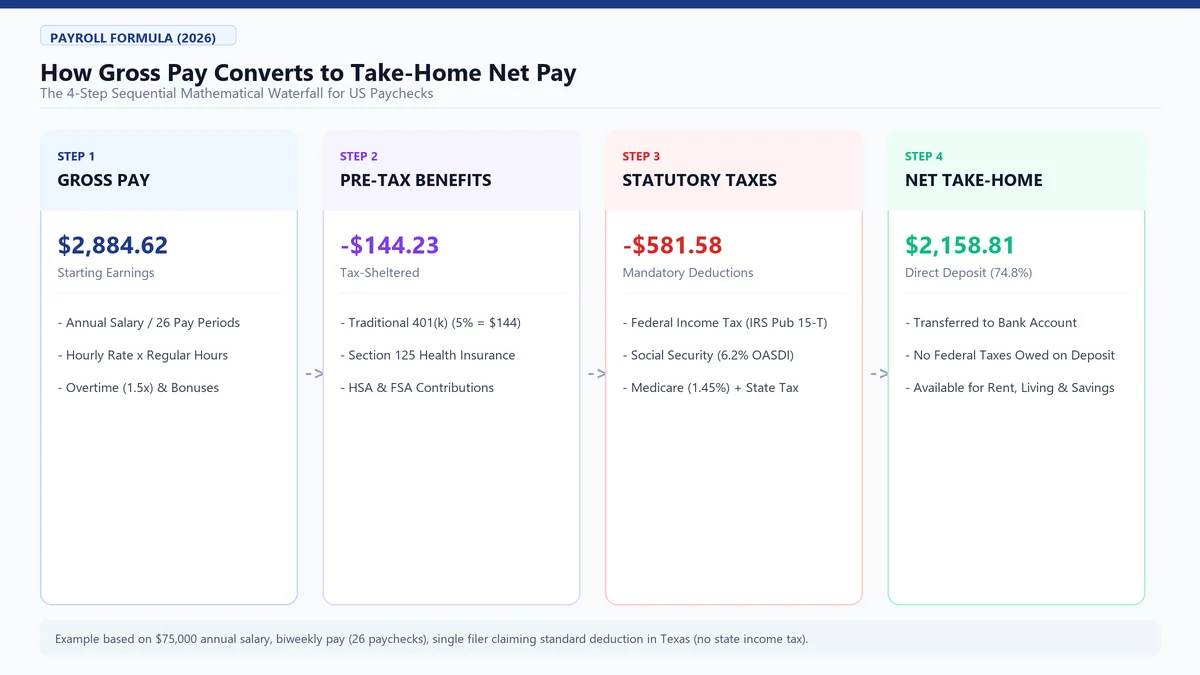
The payroll calculation begins by determining your total gross compensation for the pay period:
- Salaried Employees: Your annual base salary is divided by your employer's annual pay frequency:
- Weekly (52 pay periods): Annual Salary / 52
- Biweekly (26 pay periods): Annual Salary / 26
- Semimonthly (24 pay periods): Annual Salary / 24
- Monthly (12 pay periods): Annual Salary / 12
- Hourly Employees: Gross wages equal regular hours worked (up to 40) multiplied by your hourly rate, plus overtime hours paid at 1.5 times your regular rate:
Gross Wages = (Regular Hours ≤ 40 × Hourly Rate) + (Overtime Hours × 1.5 × Hourly Rate) + Tips + Bonuses
Step 2: Subtract Pre-Tax Benefit Deductions (Section 125 & 401k)
Before any income taxes are computed, payroll software subtracts qualified pre-tax employee benefit elections:
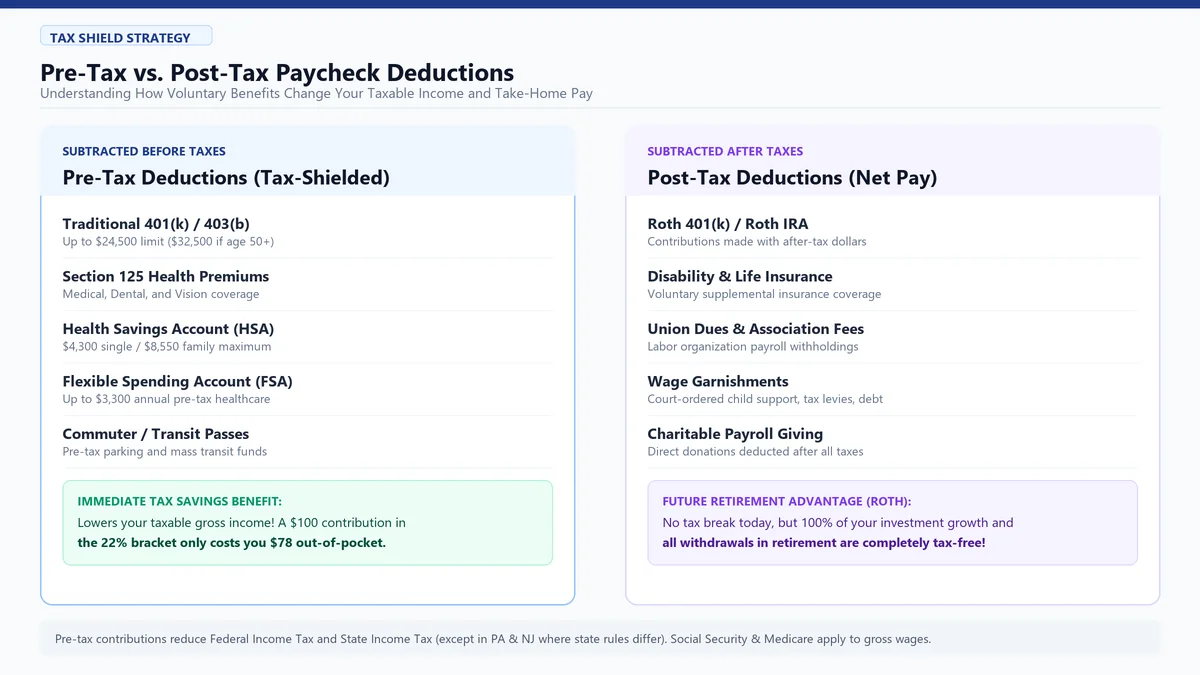
- Section 125 Cafeteria Plans: Medical, dental, and vision insurance premiums, Health Savings Accounts (HSA), and Flexible Spending Accounts (FSA). These contributions are exempt from Federal Income Tax, Social Security Tax, Medicare Tax, and State Income Tax.
- Traditional 401(k) / 403(b) Retirement: Elective deferrals reduce your taxable gross wage base for Federal and State Income Taxes, but remain subject to FICA taxes (Social Security and Medicare).
- Result = Taxable Wage Base: Gross Pay minus Pre-Tax Benefits equals the taxable wage base used in subsequent calculation steps.
Step 3: Compute FICA Payroll Taxes (Social Security & Medicare)
Next, mandatory federal FICA taxes are calculated directly on your FICA-eligible wage base:
| FICA Component | 2026 Statutory Rate | 2026 Threshold / Cap |
|---|---|---|
| Social Security (OASDI) | 6.2% | Applies up to $184,500 cumulative YTD wages (max $11,439.00/yr) |
| Standard Medicare (HI) | 1.45% | Applies to 100% of wages with no cap |
| Additional Medicare Tax | 0.9% (total 2.35%) | Applies to wages exceeding $200,000 for single filers ($250,000 married) |

Step 4: Calculate Federal Income Tax Withholding Using IRS Publication 15-T
Federal income tax withholding is calculated using the official IRS Publication 15-T Percentage Method:
- Annualize Taxable Wages: Multiply the pay period's taxable wage by your annual pay frequency (e.g., × 26 for biweekly).
- Apply Form W-4 Adjustments: Add other income (Step 4a) and subtract itemized deductions beyond standard deduction (Step 4b).
- Subtract Standard Deduction Allowance: Deduct the statutory standard deduction corresponding to your W-4 filing status ($15,700 single / $31,400 married joint in 2026).
- Calculate Tentative Annual Tax: Run the remaining taxable wage through the 2026 progressive marginal brackets (10%, 12%, 22%, 24%, 32%, 35%, 37%).
- Subtract Tax Credits & Prorate: Subtract annual child/dependent credits (W-4 Step 3), divide by pay frequency, and add extra withholding per pay period (Step 4c).
Step 5: Apply State, County, and Municipal Local Withholding
State and local withholding follows state revenue department algorithms:
- No Tax States (0%): Alaska, Florida, Nevada, New Hampshire, South Dakota, Tennessee, Texas, Washington, and Wyoming withhold $0.
- Flat Tax States: States like Illinois (4.95%) or Pennsylvania (3.07%) multiply state taxable wages by the statutory flat percentage after state personal exemptions.
- Progressive Tax States: States like California and New York apply graduated withholding brackets based on state withholding certificates (CA Form DE-4, NY Form IT-2104).
- Local City Taxes: Municipal taxes (e.g., NYC resident tax up to 3.876%, Philadelphia wage tax 3.75%) are calculated on residents or employees working within city boundaries.
Step 6: Subtract Post-Tax Deductions and Determine Net Direct Deposit
Finally, voluntary post-tax elections and court-ordered payroll deductions are subtracted from the post-tax balance:
- Post-Tax Retirement: Roth 401(k) and Roth 403(b) contributions.
- Voluntary Benefits: Supplemental life insurance, union dues, employee stock purchase plans (ESPP).
- Statutory Garnishment Orders: Court-ordered child support, alimony, unpaid tax levies, or student loan wage garnishments.
- Net Take-Home Pay: The final remaining balance is disbursed to your designated direct deposit bank account.
Common Reasons Your Paycheck Differs From a Calculator
- Your employer offers benefits with unusual tax treatment, such as pre-tax parking or dependent-care accounts.
- A city, county or school district levies a wage tax.
- Your W-4 has Step 2, 4(a) or 4(b) entries.
- Your state uses a withholding table that differs from its actual tax formula.
- Bonuses or commissions were withheld at the flat 22% supplemental rate.
A Worked Example From Gross to Net
Take a single worker in Texas earning $75,000, paid biweekly. Gross pay is $2,884.62. Federal income tax is figured on $75,000 minus the $16,100 standard deduction, which is $58,900 of taxable income. The bracket calculation gives $7,670 a year, or $295.00 per paycheck. Social Security is 6.2% of gross ($178.85) and Medicare is 1.45% ($41.83). The remainder is $2,368.94.
Check Your Own Numbers
Enter your figures in the paycheck calculator and compare the result to your latest pay stub. A gap of a few dollars is normal. A gap of tens of dollars usually points to a deduction, local tax or W-4 setting that was not entered.
Frequently Asked Questions
How is net pay calculated from gross salary?
Net pay equals Gross Salary minus Pre-Tax Benefits (401k, health) minus Federal Income Tax withholding minus Social Security (6.2%) minus Medicare (1.45%) minus State/Local Taxes minus Post-Tax Deductions.
Why is Social Security tax calculated on a different wage amount than income tax?
Traditional 401(k) contributions reduce your taxable wages for federal and state income taxes, but do NOT reduce wages for Social Security or Medicare taxes under federal law. Only Section 125 health insurance and HSA contributions reduce FICA wages.
What is the IRS Publication 15-T percentage method?
IRS Publication 15-T provides the official mathematical formulas used by payroll software to calculate federal income tax withholding based on pay frequency, taxable wages, and Form W-4 selections.
How does pay frequency affect tax calculation?
Payroll software annualizes each paycheck based on pay frequency (multiplying by 52 for weekly, 26 for biweekly, or 12 for monthly), calculates annual tax, and divides by the pay frequency. Total annual withholding is virtually identical across all frequencies.
What happens if my employer withholds too much tax?
Any excess federal or state tax withheld during the year is fully refunded to you when you file your annual tax return (Form 1040) the following spring.
How do post-tax deductions differ from pre-tax deductions?
Pre-tax deductions are subtracted before taxes are calculated, lowering your tax bill. Post-tax deductions (like Roth 401k or union dues) are subtracted after taxes are computed and do not reduce current income tax.
How these numbers are figured: 2026 IRS withholding rules (Publication 15-T) and state figures last verified September 2026. Results are estimates. Read the full methodology and sources.