Semimonthly Paycheck Calculator
Semimonthly means you are paid twice a month, usually on the 15th and the last day, for 24 paychecks a year. Enter your salary or hourly pay below to see net pay per semimonthly check after 2026 federal withholding, FICA and state taxes.
How to Use the Semimonthly Paycheck Calculator
- Enter your yearly salary, or switch to Hourly and enter rate and hours.
- Set pay frequency to Semimonthly (24 per year).
- Pick your state and filing status.
- Add benefits under More options, then read net pay per check.

Semimonthly Pay in One Line
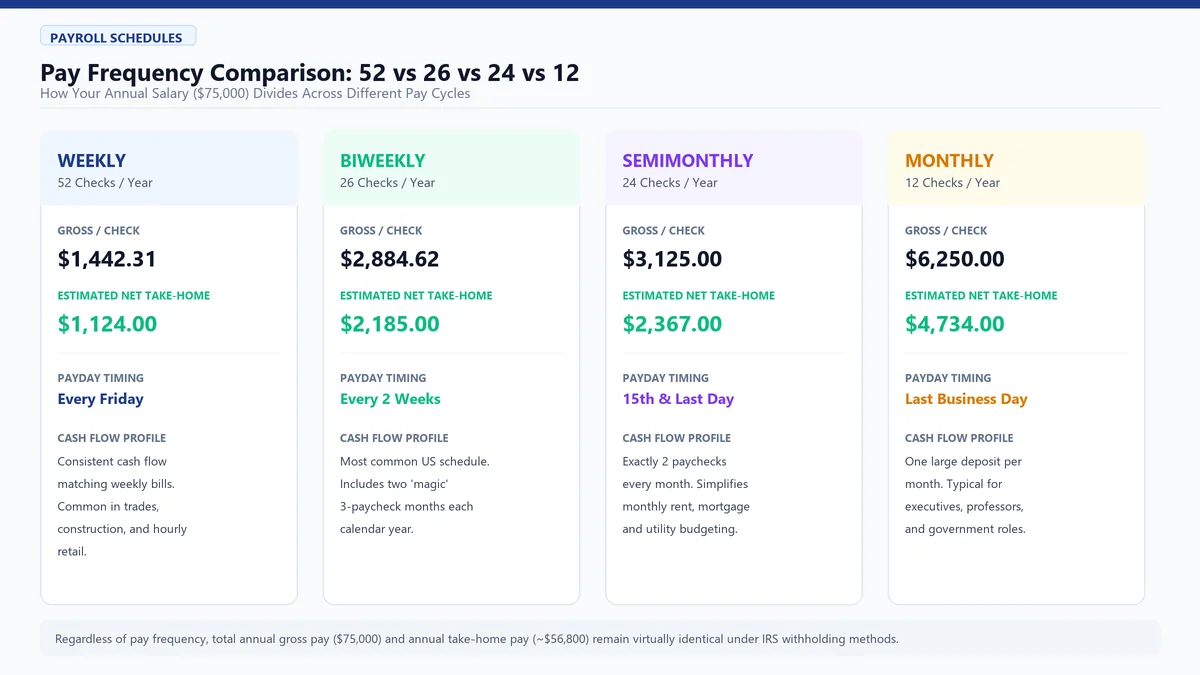
A semimonthly paycheck is your annual gross pay divided by 24. A $75,000 salary pays $3,125.00 gross per check. In Texas, for a single filer with no deductions, that becomes about $2,566.35 net per check (engine figure, 2026 rules).
Semimonthly vs Biweekly: Which Pays More?
Neither pays more over a year. Biweekly gives 26 smaller checks, and semimonthly gives 24 larger ones, so the annual total is the same. The difference is timing: biweekly has two months each year with three paychecks, while semimonthly checks land on fixed calendar dates. See the full comparison on the pay frequency page.
Why Semimonthly Checks Are Larger Than Biweekly Checks
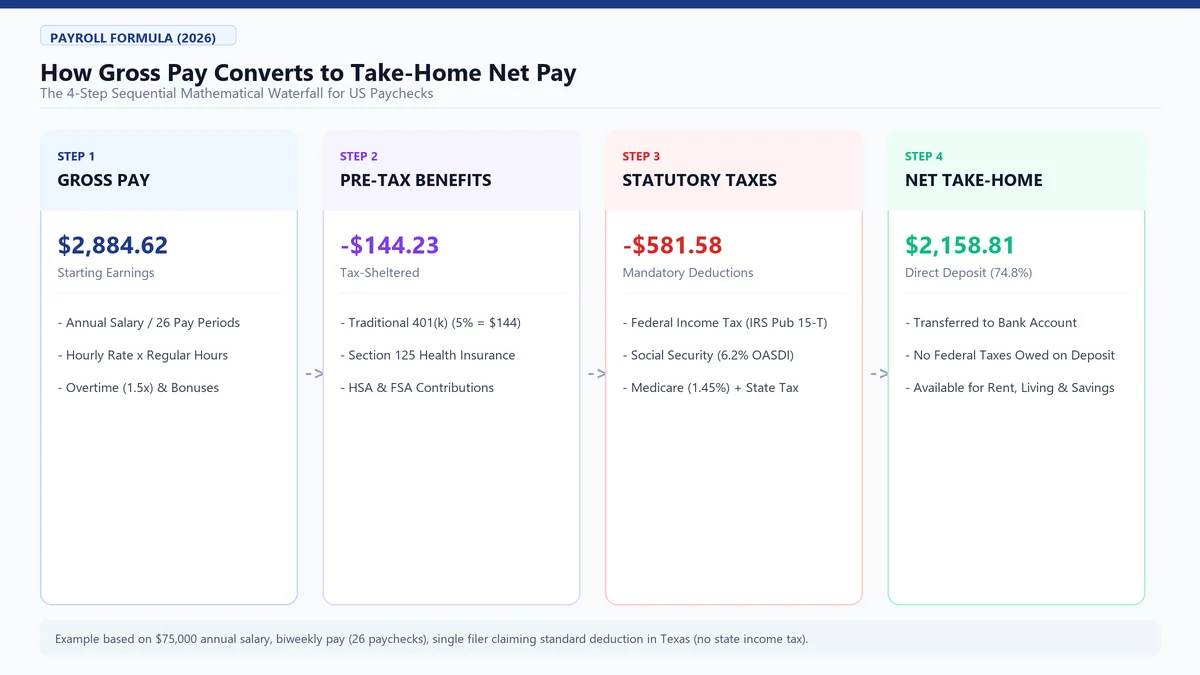
Dividing by 24 instead of 26 makes each check about 8.3% bigger. A $75,000 salary pays $3,125.00 semimonthly versus $2,884.62 biweekly. Withholding is scaled to the pay period, so federal tax per check is also higher: about $319.58 semimonthly against $295.00 biweekly.
Hourly Workers Paid Semimonthly
If you are hourly and paid semimonthly, each check covers a half-month of hours, so gross pay varies with the number of working days. A 40-hour worker earning $25 an hour averages 86.67 paid hours per period (2,080 divided by 24), or $2,166.67 gross. Use the Hourly tab for the exact figure.

Semimonthly Payday Rules
Federal law does not set how often you are paid. States do, and many require at least semimonthly or biweekly pay for most employees. Check your state labor department if you are unsure your schedule is allowed.
Example Scenarios
A $48,000 salary pays $2,000 gross per semimonthly check, $72,000 pays $3,000, and $96,000 pays $4,000. Run each with your state to see take-home. Comparing the same salary as biweekly shows smaller checks but two extra paydays a year.
Frequently Asked Questions
How do I calculate a semimonthly paycheck?
Divide your annual gross salary by 24 to get gross pay per check, then subtract federal income tax, Social Security (6.2%), Medicare (1.45%), state tax and any deductions. The calculator above does each step for you.
Is semimonthly the same as biweekly?
No. Semimonthly is twice a month (24 checks a year). Biweekly is every two weeks (26 checks a year). Semimonthly checks are about 8.3% larger for the same salary.
Is semimonthly the same as twice a month?
Yes. Semimonthly pay means two paydays per month, commonly the 15th and the last day of the month.
How much is $60,000 a year semimonthly?
$60,000 divided by 24 is $2,500.00 gross per semimonthly paycheck, before taxes and deductions.
Do I pay more tax if I am paid semimonthly?
No. Your total yearly tax depends on annual income, not on how often you are paid. Payroll figures withholding per check, so any small over- or under-withholding is settled when you file your return.
What happens on months with 31 days?
Nothing changes for salaried employees: you still get exactly two checks. Hourly workers may see slightly different gross pay because each period contains a different number of working days.
How accurate is the semimonthly paycheck calculator?
It splits your pay into 24 equal checks. Deductions billed every two weeks or hourly pay that varies with working days will differ from the estimate.
Why does my semimonthly paycheck not match a monthly estimate divided by two?
It should be close. Small differences come from withholding being figured for a 24-period year and from rounding.
How these numbers are figured: 2026 IRS withholding rules (Publication 15-T) and state figures last verified September 2026. Results are estimates. Read the full methodology and sources.
Related Calculators and Guides
Want a state-specific result? Try California, Texas, New York, Florida.
or see all state calculators.