Federal Income Tax Withholding Explained
How federal income tax is withheld from your paycheck in 2026. Explore the 2026 marginal brackets, standard deductions, Pub 15-T formulas, and the 22% bonus rule.
Federal income tax (FIT) withholding is typically the largest single tax deduction on your paystub. In 2026, federal withholding is governed by progressive marginal tax brackets ranging from 10% to 37%, the IRS Form W-4, and IRS Publication 15-T withholding tables. Below is the complete guide to how your employer calculates federal income tax on every paycheck.

2026 Federal Income Tax Brackets & Marginal Rates
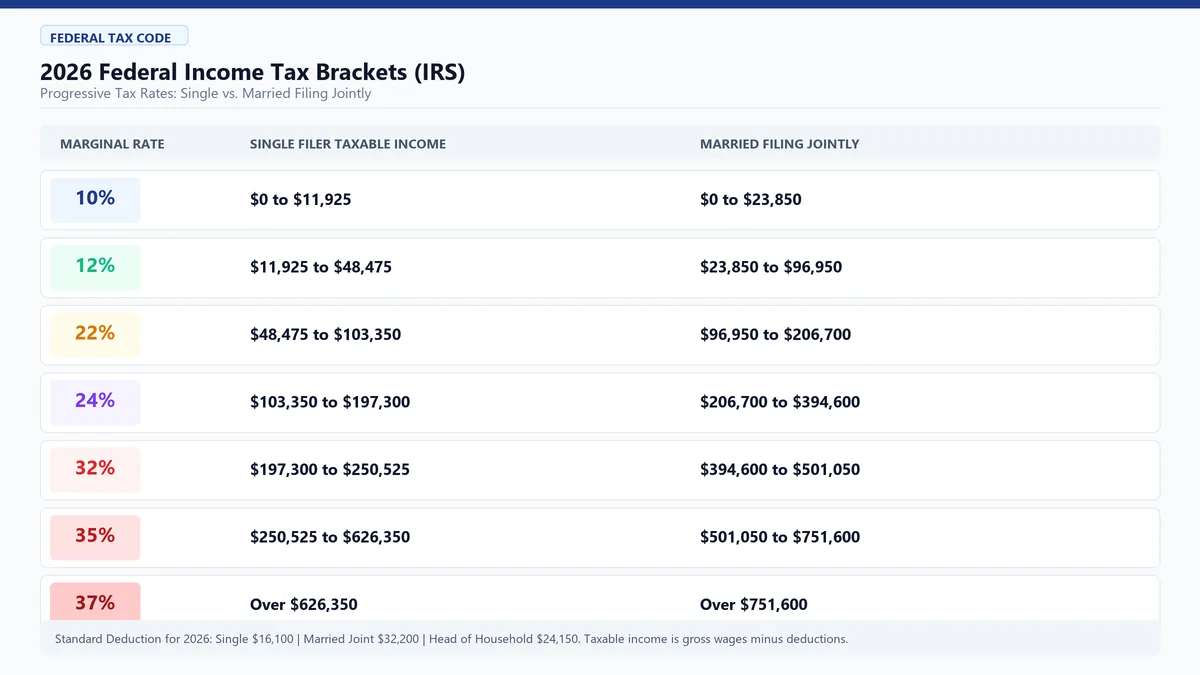
The United States uses a progressive marginal tax system. You only pay higher tax rates on dollars earned within that specific bracket threshold:
| Tax Rate | Single Filers | Married Filing Jointly | Head of Household |
|---|---|---|---|
| 10% | $0 to $11,925 | $0 to $23,850 | $0 to $17,000 |
| 12% | $11,925 to $48,475 | $23,850 to $96,950 | $17,000 to $64,850 |
| 22% | $48,475 to $103,350 | $96,950 to $206,700 | $64,850 to $103,350 |
| 24% | $103,350 to $197,300 | $206,700 to $394,600 | $103,350 to $197,300 |
| 32% | $197,300 to $250,525 | $394,600 to $501,050 | $197,300 to $250,500 |
| 35% | $250,525 to $626,350 | $501,050 to $751,600 | $250,500 to $626,350 |
| 37% | Over $626,350 | Over $751,600 | Over $626,350 |
2026 Standard Deduction Thresholds by Filing Status
Your standard deduction protects a baseline portion of your annual earnings from federal income tax entirely. In 2026, the IRS standard deductions are:
- Single Filers: $15,700 ($603.85 per biweekly paycheck exempt from FIT).
- Married Filing Jointly: $31,400 ($1,207.69 per biweekly paycheck exempt from FIT).
- Head of Household: $23,500 ($903.85 per biweekly paycheck exempt from FIT).
- Married Filing Separately: $15,700 ($603.85 per biweekly paycheck exempt from FIT).
How Payroll Software Calculates Federal Withholding (IRS Pub 15-T)
Payroll systems like ADP, Gusto, Workday, and Paychex use the IRS Publication 15-T Percentage Method to calculate withholding on each paycheck:
- Step A: Annualize Current Period Taxable Wages: Biweekly Taxable Wages × 26 pay periods.
- Step B: Adjust for Form W-4: Add Step 4(a) Other Income; subtract Step 4(b) Deductions.
- Step C: Subtract Standard Deduction: Subtract $15,700 (Single) or $31,400 (Married Joint).
- Step D: Compute Annual Tax across 2026 Brackets: Tax is calculated bracket by bracket.
- Step E: Prorate to Pay Period: Divide total annual tax by 26, subtract Step 3 tax credits per period (e.g. $2,000 Child Tax Credit / 26 = $76.92/check credit), and add Step 4(c) Extra Withholding.

Supplemental Wage Withholding: Bonuses, Commissions & Stock Vesting
When you receive payments outside your regular salary — such as annual bonuses, sales commissions, or RSU stock vesting — the IRS classifies these as supplemental wages:
- Flat 22% Federal Withholding Rate: For supplemental wages up to $1,000,000 in a calendar year, employers typically withhold a flat 22% federal income tax (plus 7.65% FICA and state tax).
- 37% Mandatory High-Earner Rate: Supplemental wages exceeding $1,000,000 within a calendar year are subject to mandatory 37% federal withholding on the excess.
- Aggregate Method: If your employer combines your bonus with your regular paycheck into a single lump sum, the entire total is taxed as regular wages, often withholding at a temporarily higher marginal rate.
Withholding vs Actual Tax Liability: Avoiding Large Tax Bills or Massive Refunds
Your paycheck withholding is simply an ongoing estimate. Achieving a balanced withholding ensures financial efficiency:
- The Large Refund Trap: A $4,000 tax refund means you overpaid taxes by $333 every month — giving the federal government an interest-free loan.
- Avoiding Underpayment Penalties: If you owe more than $1,000 at tax time and did not withhold at least 90% of current-year liability (or 100%/110% of prior-year liability), the IRS assesses underpayment penalties.
- Fine-Tuning Form W-4: Submit an updated Form W-4 with your HR department anytime you get married, have a child, buy a home, or experience significant changes in non-wage income.
Federal Withholding Examples
For a single filer earning $75,000 and paid biweekly, federal withholding is about $295.00 per paycheck. A married couple filing jointly with one earner at the same salary sees a lower figure because of the $32,200 standard deduction and wider brackets. The filing status guide shows the comparison.
Marginal Rate Versus Effective Rate
Your marginal rate is the rate on your last dollar of taxable income. Your effective rate is total tax divided by total income and is always lower. A single filer at $75,000 sits in the 22% marginal bracket but pays about 10% of gross pay in federal income tax. Extra income is taxed at the marginal rate, which is why overtime can feel heavily taxed even though only the top slice is.
Ways to Legally Lower Federal Withholding
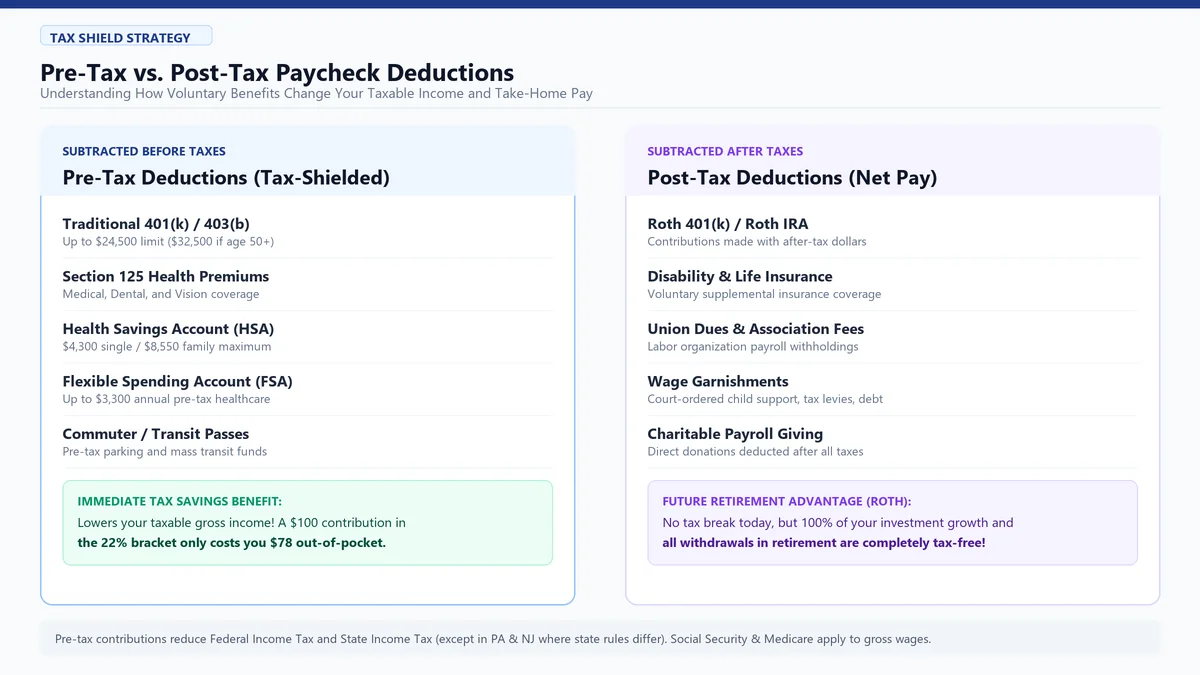
- Contribute to a traditional 401(k), HSA or FSA.
- Claim dependents and credits on Step 3 of the W-4.
- Enter deductions above the standard deduction on Step 4(b).
- Remove extra withholding on Step 4(c) if you receive large refunds.
Never reduce withholding so far that you owe a penalty. See paycheck withholding for the safe-harbor rules.
Bonus Withholding at a Glance
Bonuses paid separately are commonly withheld at a flat 22% federal rate, and at 37% above $1 million of supplemental wages in a year. If the bonus is combined with regular pay, your W-4 method applies instead. Either way the final tax is settled on your return. The full comparison with a table is in paycheck withholding.
Federal Withholding and the 2025 Overtime and Tips Deductions
The deductions for qualified overtime and tips are claimed on your tax return and do not change the withholding formula here. See no tax on overtime and tips. For bonus withholding, see bonus tax.
Frequently Asked Questions
What is the federal income tax rate on my paycheck in 2026?
Federal withholding is progressive and ranges from 10% to 37% based on your taxable wages. Most single workers earning $50,000 to $100,000 experience an effective federal withholding rate between 8% and 14% of gross pay.
What is the 2026 standard deduction?
In 2026, the standard deduction is $15,700 for Single filers, $31,400 for Married Filing Jointly, and $23,500 for Head of Household.
Why is a bonus withheld at 22% instead of my normal tax rate?
IRS rules allow employers to use a simplified flat 22% supplemental withholding rate on bonuses, commissions, and severance pay up to $1 million.
How do I reduce federal tax withholding on my paycheck?
You can lower federal tax withholding by claiming eligible child tax credits in Step 3 of Form W-4, entering expected itemized deductions in Step 4(b), or increasing pre-tax 401(k) and HSA contributions.
What is IRS Publication 15-T?
IRS Publication 15-T (Federal Income Tax Withholding Methods) contains the official mathematical tables and percentage methods used by employers and payroll software to compute federal withholding.
Does overtime push all my income into a higher tax bracket?
No. Moving into a higher tax bracket only taxes the specific dollars earned above that bracket threshold at the higher rate. Your base earnings continue to be taxed at lower bracket percentages.
How these numbers are figured: 2026 IRS withholding rules (Publication 15-T) and state figures last verified September 2026. Results are estimates. Read the full methodology and sources.